Quick Answer: Spa and wellness brands typically need three core glass categories: amber essential oil bottles, reed diffuser vessels, and heat-resistant candle jars. Consolidating all three into a single order with one Chinese manufacturer reduces supplier management workload, lowers per-category MOQ pressure, cuts inspection and freight costs, and keeps glass color and decoration consistent across the entire product line.
- A complete spa product line usually spans three to five glass categories, from 10ml amber oil bottles to 300ml candle vessels.
- Splitting these categories across multiple suppliers multiplies sample rounds, QC inspections, and freight bookings.
- Amber tint, frosting shade, and logo decoration rarely match between different factories, breaking shelf consistency.
- One consolidated order can mix categories in a single container with one inspection and one production schedule.
Is your spa brand managing four different glass suppliers just to stock one treatment room? Most wellness brands start this way: an essential oil bottle vendor found on a B2B platform, a diffuser vessel supplier recommended by a friend, and a candle jar factory discovered at a trade show. Each relationship works in isolation, yet together they quietly drain margin through duplicated samples, mismatched glass tones, and half-empty shipping cartons. This guide maps the full glass packaging needs of a spa and wellness product line, breaks down the hidden costs of fragmented sourcing, and shows how a consolidated order from a single manufacturer works in practice.
What Glass Packaging Does a Spa or Wellness Brand Actually Need?
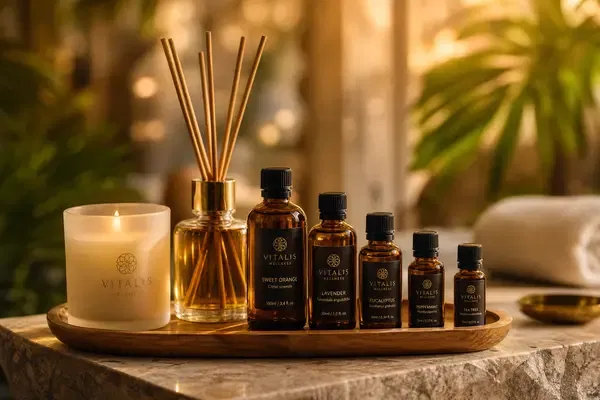
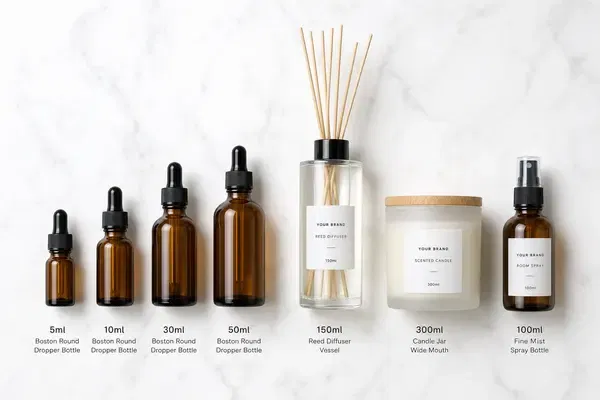
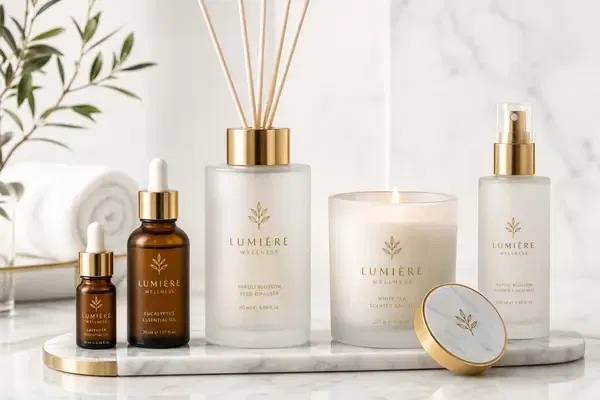
A typical spa or wellness product line runs on three core glass categories: amber essential oil bottles in the 5–100ml range, reed diffuser vessels between 100ml and 200ml, and heat-resistant candle jars from 200ml to 400ml. The wider the brand’s service menu, the longer this list becomes. Massage and treatment oils call for Boston round bottles with droppers or lotion pumps; room and linen sprays need fine-mist spray bottles; bath salts and body scrubs sit best in wide-mouth jars; and retail gift sets often add small decorative bottles for single-use samples.
The spending power behind this demand is substantial. The global wellness economy reached $6.8 trillion in 2024 and is projected to grow 7.6% annually through 2029—nearly twice the pace of global GDP[1]. Home fragrance follows the same curve: the candle market alone was valued at $21.3 billion in 2025 with steady growth forecast through 2035[2]. For spa operators and wellness brands, packaging is where that premium positioning becomes visible on the shelf.
Glass color is not a styling decision here—it is a shelf-life decision. Amber glass blocks over 99% of UV rays below 450nm, which is why it remains the default for light-sensitive essential oils, facial serums, and botanical extracts. Clear or frosted glass, on the other hand, suits diffuser vessels and candle jars, where the liquid level or wax color is part of the visual appeal. If your line includes serums or facial oils, the dropper assembly deserves as much attention as the bottle itself; our guide to choosing the right glass dropper bottle covers neck finishes, pipette lengths, and liner compatibility in detail. For scent-focused products, purpose-made aromatherapy and diffuser bottles are engineered with narrow necks that slow evaporation while holding reed sticks upright.
One distinction worth planning early is back-bar versus retail sizing. Professional treatment products used by therapists—massage oil blends, cleansing oils, salt scrubs—typically run in larger 250ml to 1-liter formats with pumps for speed and hygiene, while the retail versions of the same formulas sell in 30ml to 100ml sizes at the front desk. The same stock mold family often covers both, which keeps the shelf and the treatment room visually connected and lets both size tiers count toward the same order quantity.
Why Does Sourcing Spa Glass from Multiple Suppliers Cost More Than You Think?
Fragmented sourcing multiplies every fixed cost in the procurement cycle: each additional supplier means another round of samples, another quality inspection booking, another freight arrangement, and another set of payment terms to negotiate. A brand buying oil bottles, diffuser vessels, and candle jars from three separate factories effectively runs three procurement projects in parallel—each with its own communication overhead, its own defect standards, and its own lead time that must somehow align with a single product launch date.
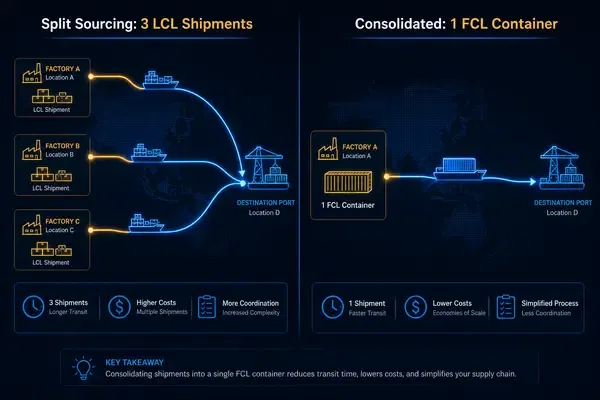
The freight penalty is the most visible cost. Three suppliers in different cities usually means three LCL (less-than-container-load) shipments, and LCL rates per cubic meter run far higher than FCL (full container) rates because consolidators charge for handling, deconsolidation, and warehouse time at both ends. A mixed order that fills one 20-foot container as FCL almost always lands cheaper per unit than the same goods split across three LCL bookings—before even counting the tripled customs documentation.
The less visible cost is visual inconsistency. Amber glass tint varies measurably between furnaces, because it depends on the iron and sulfur chemistry of each factory’s raw material batch. Frosting depth, spray-color shade, and logo print registration vary the same way. A retail shelf where the oil bottle reads honey-amber, the diffuser reads brown-amber, and the candle jar’s frosting is two tones lighter than the spray bottle’s quietly signals “assembled from parts” rather than “designed as a collection”—the opposite of what a premium wellness brand pays for.
A Glimpse into Glass History: Glass and wellness have traveled together for two millennia: Roman glassmakers mass-produced unguentaria—small teardrop-shaped vessels for scented oils and balms—which archaeologists have unearthed from bathhouse sites across the entire former empire, from Britain to Syria.
How Can One Consolidated Order Cover Oil, Diffuser, and Candle Vessels?
A manufacturer that holds in-house molds across multiple categories can combine essential oil bottles, diffuser vessels, and candle jars into one production schedule, one pre-shipment inspection, and one container—which is exactly how a consolidated spa order works. Stock molds are the key: because the factory already runs standard Boston rounds, diffuser shapes, and candle tumblers continuously, each category can be produced at its own realistic quantity instead of forcing the buyer to hit a separate custom-mold MOQ for every shape. Decoration is then applied in the same finishing workshop, so the frosting bath, spray-color batch, and silk-screen setup stay identical across all vessels in the collection.
| Factor | Split Sourcing (3–4 Suppliers) | Consolidated Order (1 Manufacturer) |
|---|---|---|
| Sample rounds | One per supplier, separate couriers | One combined sample shipment |
| Quality inspection | Multiple bookings at different sites | Single pre-shipment inspection |
| Freight mode | Multiple LCL shipments | One FCL container, mixed loading |
| Color & decoration consistency | Varies between factories | Same furnace batch, same finishing line |
| MOQ pressure | Full MOQ per supplier per shape | Stock-mold quantities combined in one PO |
| Launch timeline risk | Slowest supplier delays everything | One coordinated production schedule |
Container math also works in the buyer’s favor. Small oil bottles nest efficiently in the void space that bulky candle jars and diffuser vessels leave in a container, so mixed loading routinely reaches higher cubic utilization than any single-category shipment. Palletizing, divider specs, and export cartons are planned once, by one warehouse team, against one packing list.
I saw this play out with a wellness brand from Europe that came to us after two seasons of split sourcing. They were ordering 20,000–50,000 units per season across amber oil bottles, reed diffuser vessels, and frosted candle jars, spread over three suppliers in two provinces. Their two recurring complaints were amber tone mismatch between the oil line and the diffuser line, and a launch delayed by the slowest of the three factories. We consolidated the program into one mixed order: all amber items pulled from the same furnace campaign, all frosting run in the same workshop batch, one third-party inspection, one 20-foot container. The brand kept its existing bottle shapes—every vessel came from stock molds—so no mold fee was involved, and the coordination workload on their side dropped from three supplier threads to one.
MOQ mechanics and quality checkpoints for the candle jar portion of a mixed order follow the same rules as a standalone candle order; our 2026 guide to sourcing glass candle jars from China breaks down MOQ tiers, mold fees, and the thermal-shock testing that heat-exposed vessels require.
Conclusion: Solving the Spa Packaging Coordination Problem
A spa or wellness product line is, from a packaging standpoint, a coordination problem: three to five glass categories that must look like one family, arrive on one launch date, and fit one budget. Fragmented sourcing solves each category individually while quietly failing the collection as a whole—through tint mismatch, duplicated inspections, and multiplied freight. Consolidating the program with a single manufacturer that carries stock molds across oil bottles, diffuser vessels, and candle jars turns three procurement projects back into one.
If you are planning a spa or wellness packaging program and want to see whether your full vessel list can run as one consolidated order, share your product line with us. We will map every item against our stock molds and quote the program as a single container. Contact us today at sales@glassypack.com or visit our Contact Us page to get started.
FAQ
For stock-mold items, each shape carries its own minimum—commonly starting around 2,000 pieces per item for in-stock designs—and the quantities combine into one purchase order. Consolidation does not remove per-shape minimums, but it lets you meet them across a whole collection instead of per supplier.
Yes. Mixed loading is standard practice: heavier candle jars are palletized low, lighter cartons of small bottles fill the upper and void space. One packing list, one bill of lading, and one customs entry cover the entire collection.
Amber is the industry default because it blocks over 99% of UV light below 450nm, protecting terpenes and active botanical compounds. Cobalt blue offers partial protection with a distinct look; clear glass should be reserved for oils with short shelf lives or opaque secondary packaging.
Not necessarily. A one-stop glass manufacturer typically supplies matched closures—droppers, lotion pumps, mist sprayers, and diffuser collars—alongside the vessels, tested for fit on the exact neck finish of each bottle before shipment.
For stock-mold items with standard decoration, production typically runs 25–40 days after sample approval, plus ocean freight. Custom decoration such as electroplating or multi-color printing can add one to two weeks to the schedule.
Yes, and this is a core advantage of consolidation: frosting, spray color, and silk-screen printing are applied in the same finishing workshop under one color standard, so every vessel in the collection matches within the same tolerance band.
References
[1] Global Wellness Institute. (2024). Wellness Economy Statistics & Facts. https://globalwellnessinstitute.org/press-room/statistics-and-facts/
[2] Global Market Insights. (2025). Candle Market Size & Share, Forecasts 2026–2035. https://www.gminsights.com/industry-analysis/candle-market