Quick Answer: As the tequila boom cools into a crowded, more selective market in 2026, packaging has become a make-or-break differentiator. Five custom glass bottle design trends define the premium segment: ultra-heavy glass weights (800g+) for US premium positioning, agave-inspired sculptural forms, earth-toned and smoke-colored glass replacing clear flint, natural closures like agave wood and ceramic, and “lightweight luxury” driven by EU sustainability regulations.
- Tequila’s years of explosive growth have normalized: US demand has softened, major producers are managing a category-wide agave and liquid surplus, and IWSR projects global volume growth slowing to roughly 2% CAGR through 2030.
- With more than 2,000 expressions competing on the shelf, “another premium tequila” is no longer enough — differentiation through provenance, quality, and presentation has become mandatory.
- Heavyweight glass (often exceeding 800g empty) remains the dominant premium cue in the US, tequila’s largest market — but hard price ceilings mean the packaging investment must be matched by credible quality.
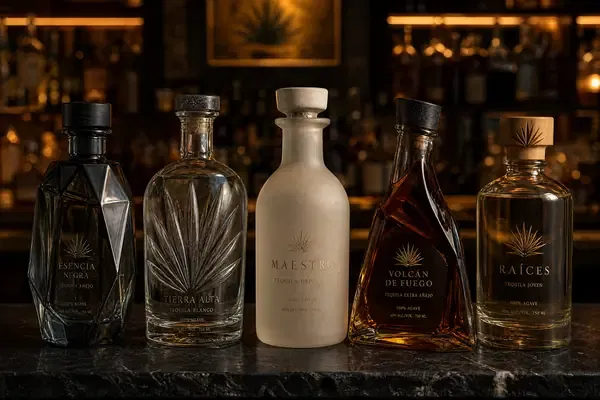
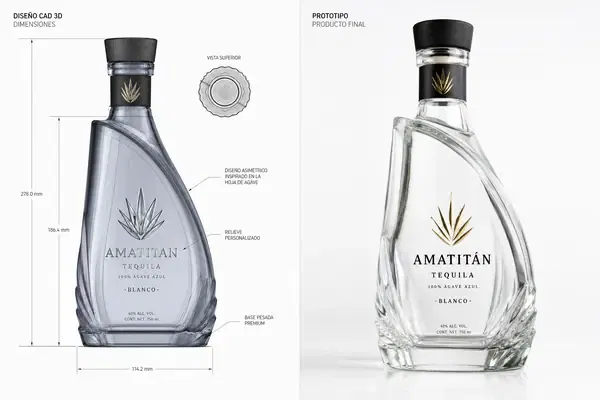
- Brands are moving away from standard cylinders toward complex, asymmetric molds inspired by the agave plant’s organic shapes.
- While the US rewards heavy glass, EU regulations are pushing brands toward “lightweight luxury” — premium aesthetics achieved with less glass weight.
The tequila category is entering a new phase. After a decade of explosive, headline-grabbing growth, demand has normalized. Major producers who once raced to keep up with US demand are now openly managing a slowdown: Diageo has reported double-digit declines for its US tequila business, the industry is working through an estimated 100–200 million liters of surplus liquid, and IWSR data shows the $50–$60 price band in the US contracting by nearly 9% in volume over the past year. [1] [2]
Counterintuitively, this recalibration makes packaging more important, not less. During the boom years, a rising tide lifted every bottle on the shelf. Today, with more than 2,000 tequila expressions competing for attention and consumers scrutinizing every dollar above $50, brands must visibly earn their price tags. The shelf is too crowded to carry look-alikes. In this environment, the bottle is no longer decoration — it is the first and often only argument a brand gets to make before a purchase decision. Brands that survive the shakeout are the ones investing in custom glass bottle design that communicates authenticity, craft, and provenance at a glance. If you are a spirits brand owner or procurement manager planning a tequila launch or refresh in 2026, relying on a stock bottle is no longer a viable strategy. This guide explores the five custom glass bottle design trends that are defining winners in today’s more demanding premium tequila market.
Trend 1: Ultra-Heavy Glass as the Ultimate Premium Signal
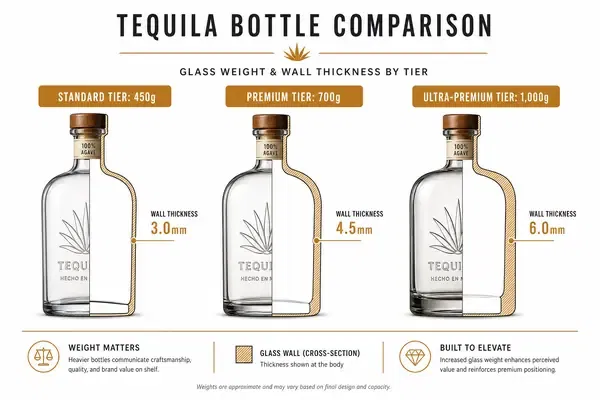
In the US — by a wide margin the world’s largest tequila market, accounting for over two-thirds of global consumption [3] — weight is inextricably linked to perceived quality. When a consumer picks up a $150 bottle of Extra Añejo, the physical heft of the glass validates the price point before the bottle is even opened. Five years ago, a 750ml tequila bottle weighing 600g empty was considered premium. Today, that weight has become the baseline for standard-tier products.
For ultra-premium launches in 2026, empty liquor bottle weights routinely range from 800g to 1,200g. This is achieved through exceptionally thick glass bases (often referred to as a “glass heel”) that can be up to an inch thick, and reinforced sidewalls. [4] However, this trend demands more financial discipline than it did during the boom. Producing ultra-heavy glass requires longer cooling times in the mold, slowing production speeds and increasing unit cost, and a heavier bottle significantly increases freight cost per container. With IWSR forecasting a roughly 5% contraction in super-premium tequila volumes through 2030 and hard price ceilings emerging in the US market, [2] brands must model landed costs carefully when specifying glass weights above 800g — and make sure the liquid and the story justify the package. Heavy glass on top of a weak product is exactly the kind of look-alike proposition today’s market punishes.
A Glimpse into Tequila History: The association between heavy, ornate packaging and premium tequila is relatively new. For more than a century, the tequila industry was dominated by a few massive distilleries focused on volume. It wasn’t until the late 1980s and 1990s, with the introduction of 100% blue agave sipping tequilas, that brands began experimenting with artisan glass and ceramic decanters to differentiate themselves from the “mixto” tequilas meant for shooting. Then, as now, packaging innovation was born from the need to stand apart in a changing market.
Trend 2: Agave-Inspired Sculptural and Asymmetric Forms
The dominant shape direction in premium tequila is a definitive move away from standard cylindrical or shouldered spirits profiles. Instead, brands are investing in complex custom molds that visually reference the agave plant itself — the botanical source of tequila and a powerful cultural identity marker. In a market where differentiation must be real rather than claimed, a proprietary sculptural form is one of the few brand assets a competitor cannot copy overnight.
This manifests in several distinct design languages. We are seeing tapered, leaf-like profiles that suggest the elongated leaves of the blue agave, widest at the shoulder and tapering to a narrow base. Angular, faceted bodies are also popular, inspired by the geometric cross-section of a harvested agave piña (the heart of the plant). More recently, organic, asymmetric forms that deliberately avoid perfect symmetry are gaining traction, evoking a sense of handcraft and natural materials.
These sculptural designs require highly specialized mold engineering. The irregular wall thickness distribution in asymmetric bottles makes them challenging to manufacture without defects. When sourcing these designs, it is critical to partner with a glass manufacturer experienced in complex, multi-part molds to ensure consistent quality and avoid high rejection rates during production. If you are exploring this route, our guide on how to design a custom spirit bottle from concept to production outlines the entire engineering process.
Trend 3: Earth Tones and Smoke Glass Replacing Clear Flint
Clear flint glass has historically dominated tequila production, allowing the natural color progression from Blanco (clear) to Reposado (gold) to Añejo (amber) to be the focal point. However, as the premium shelf becomes increasingly crowded, brands are utilizing tinted glass to stand out.
In 2026, smoke gray, dark amber, terracotta-tinted, and deep olive green glass are becoming highly sought after. These earthy, muted tones connect the product to the volcanic soil of the Jalisco terroir. Furthermore, dark glass provides genuine UV protection, which is essential for preserving the complex flavor profiles of expensive Extra Añejo expressions.
| Glass Color / Finish Trend | Brand Positioning | Sourcing Implication |
|---|---|---|
| Smoke Gray / Charcoal | Modern luxury, nightlife, ultra-premium Blanco | Requires specific furnace runs; MOQs are typically higher than standard flint. |
| Dark Amber / Terracotta | Heritage, artisanal craft, Extra Añejo protection | Excellent UV protection; widely available but custom shapes require new molds. |
| Frosted / Matte Finish (surface treatment) | Elegance, tactile engagement, minimalist design | Applied as a secondary process (acid etching or spray coating); adds unit cost but does not require a new glass mold. |
Trend 4: Natural and Artisanal Closures
The closure is the final tactile interaction a consumer has before pouring the spirit. In the premium tequila segment, standard plastic or basic aluminum closures have been entirely replaced by natural materials that reference Mexican craft traditions.
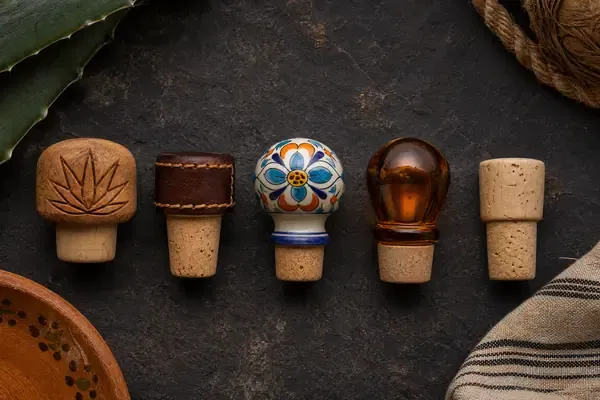
Agave wood stoppers, carved from the same plant used to make the spirit, provide a powerful, direct provenance narrative. We are also seeing heavy adoption of oversized natural corks wrapped in leather or sisal fiber. At the very top of the market, hand-painted ceramic stoppers and bespoke hand-blown glass closures are used to elevate the bottle into a collectible display object. When specifying these heavy, oversized closures, it is vital to ensure the glass bottle’s neck finish is engineered to support the extra weight without risking micro-fractures during transport. For more on ensuring a perfect seal, review our liquor bottle leakage and neck finish guide.
From Our Order Files: The Ceramic Stopper Challenge. A boutique tequila brand launching a $200 Reposado designed a stunning, oversized ceramic stopper. However, during their initial transit tests with a different supplier, the heavy stopper acted like a pendulum, causing the glass neck to crack. When they brought the project to GlassyPack, our engineering team redesigned the bottle’s neck profile, increasing the glass thickness at the transfer bead and adjusting the cork’s insertion depth. The result was a structurally sound bottle that maintained the brand’s luxurious aesthetic without a single breakage during the final shipping trials.
Trend 5: The “Lightweight Luxury” Paradox (Driven by the EU)
While the US market continues to reward ultra-heavy glass, brands looking to expand globally face a contradictory trend: the regulatory push for sustainability and lightweight packaging in Europe. The EU’s Packaging and Packaging Waste Regulation (PPWR) is forcing spirits brands to rethink excess packaging weight and empty space. [5] For brands seeking growth outside a slower US market — a strategic priority many producers now share — EU compliance is not optional.
This has birthed the “lightweight luxury” trend. Brands are challenged to maintain a premium aesthetic while reducing the actual grams of glass used. How is this achieved? Through ingenious mold design. Deep push-ups (punts) at the base, intricate embossing, and sharp, faceted shoulders can make a 600g bottle look and feel as substantial as an 850g bottle. Furthermore, utilizing high percentages of Post-Consumer Recycled (PCR) glass is becoming a badge of honor rather than a compromise, appealing to environmentally conscious consumers without sacrificing the luxury positioning.
Conclusion: Designing for Tequila’s More Demanding Decade
The tequila gold rush is over — and that is precisely why packaging strategy matters more than ever. In a recalibrated market where consumers enforce price ceilings, retailers rationalize crowded shelves, and even celebrity backing no longer guarantees success, every element of a brand must pull its weight. The winners of this next phase will not be the brands that simply spent the most on glass, but those whose packaging tells a true story: heavy, sculptural glass that matches genuine liquid quality in the US; intelligent, lightweight luxury that meets regulatory reality in Europe; colors, forms, and closures that authentically express Mexican provenance rather than imitating the last successful launch. To understand how the category arrived at this inflection point, our overview of the evolution of glass bottle design in spirits provides useful context.
A stock bottle cannot do any of that. Success in this category now requires custom mold investment, a clear-eyed understanding of your landed costs, and a design partner who can translate ambition into manufacturable reality. If you are developing a new tequila brand or repositioning an existing one for this more selective market, GlassyPack’s engineering team can help you navigate these trends. We specialize in translating complex, sculptural designs into high-quality glass bottles that perform flawlessly on the filling line. Contact us at sales@glassypack.com or visit our Contact Us page to discuss your custom tequila bottle project.
FAQ
In the US market, a 750ml tequila bottle weighing 600g empty is now considered the baseline for standard-tier products. Ultra-premium launches in 2026 typically specify empty bottle weights between 800g and 1,200g. However, brands should carefully model landed costs at these weights, as heavier glass increases both production time and freight cost per container — and the liquid quality must justify the packaging investment.
Custom glass bottle mold costs vary significantly based on design complexity. A standard single-cavity mold for a straightforward shape typically starts at $1,500–$2,000 USD. Complex, multi-part molds required for asymmetric or sculptural agave-inspired designs can range from $3,000 to $4,000 or more. Brands can reduce per-unit mold amortization by sharing base molds across a product line and differentiating through surface treatments (frosting, embossing) rather than entirely new molds for each SKU.
MOQs for custom-colored glass (such as smoke gray, terracotta, or deep olive green) are typically higher than for standard clear flint glass, because colored glass requires dedicated furnace runs. Most manufacturers set MOQs for custom colors at 200,000–500,000 units per order. For smaller craft brands, it is worth discussing semi-custom options — such as applying a frosted or color sprayed surface treatment to a standard flint bottle — which can achieve a premium aesthetic at lower MOQs of 2,000–5,000 units.
Heavy, oversized closures (ceramic, agave wood, hand-blown glass) act as a pendulum during transit, placing stress on the bottle’s neck. To prevent micro-fractures, the bottle’s neck profile must be engineered to support the closure weight: this typically involves increasing glass thickness at the transfer bead, adjusting the cork’s insertion depth, and specifying a neck finish with a wider bearing surface. Always conduct drop and vibration transit tests before committing to a full production run.
Yes. The EU Packaging and Packaging Waste Regulation (PPWR) introduces restrictions on unnecessary packaging weight and empty space ratios. For tequila brands expanding into European markets, this means ultra-heavy glass bottles designed for the US market may not be compliant — or may face regulatory scrutiny — in the EU. The practical response is the “lightweight luxury” approach: achieving premium aesthetics through design ingenuity (deep punts, sharp facets, intricate embossing) rather than sheer glass weight, while also incorporating Post-Consumer Recycled (PCR) glass content.
References
[1] Forbes. Ten Major Trends Shaping The Tequila Industry In 2026. https://www.forbes.com/sites/joemicallef/2026/01/03/ten-major-trends-shaping-the-tequila-industry-in-2026/
[2] The Spirits Business (citing IWSR data). Super-premium Tequila faces 5% drop by 2030. https://www.thespiritsbusiness.com/2026/07/super-premium-tequila-faces-5-drop-by-2030/
[3] IWSR Drinks Market Analysis. Tequila’s growth story enters a new chapter. https://www.theiwsr.com/insight/tequilas-growth-story-enters-a-new-chapter/
[4] LiquorGlassBottles.com. Tequila Bottle Packaging Trends 2026: Design, Capacity & Sourcing Guide. https://www.liquorglassbottles.com/tequila-bottle-packaging-trends-guide.html
[5] FEVE (European Container Glass Federation). Position Proposal for a Packaging and Packaging Waste Regulation. https://feve.org/wp-content/uploads/2023/03/FEVE-position-PPWR-proposal-March-2023-FINAL.pdf