Quick Answer: Crown caps are the commercial standard for bottled beer: a 26mm finish, reliable pressure retention, and compatibility with standard high-speed capping lines at the lowest unit cost. Swing tops are reusable and reclosable, which suits craft and homebrew formats, but they cost more per unit, require a specific neck profile, and depend on gasket condition.
- The 26mm crown finish is the global standard for beer; 29mm is used mainly for wine and champagne-style bottles.
- Crown caps seal once and seal reliably; swing tops trade a little sealing certainty for the ability to reclose.
- A crown cap’s liner can be specified for oxygen scavenging or barrier performance; a swing top’s rubber gasket cannot.
- Swing tops need a bottle designed for them — the wire bail anchors into a collar formed on the neck, which is a mold feature, not an accessory.
- Our stock beer bottles are supplied with crown finishes; swing-top availability depends on the specific bottle profile and has to be confirmed before ordering.
Is a swing top a packaging upgrade, or just a more expensive way to close the same bottle? It is one of the most common closure questions we get from craft brewers, and the honest answer depends less on the closure itself than on three things: your filling equipment, your unit economics, and whether the bottle you have chosen was designed to accept a wire bail at all. This guide separates what each closure actually does from what buyers assume it does, and sets out what each one costs in money, minimum order quantity, and lead time.
How does each closure actually seal the bottle?
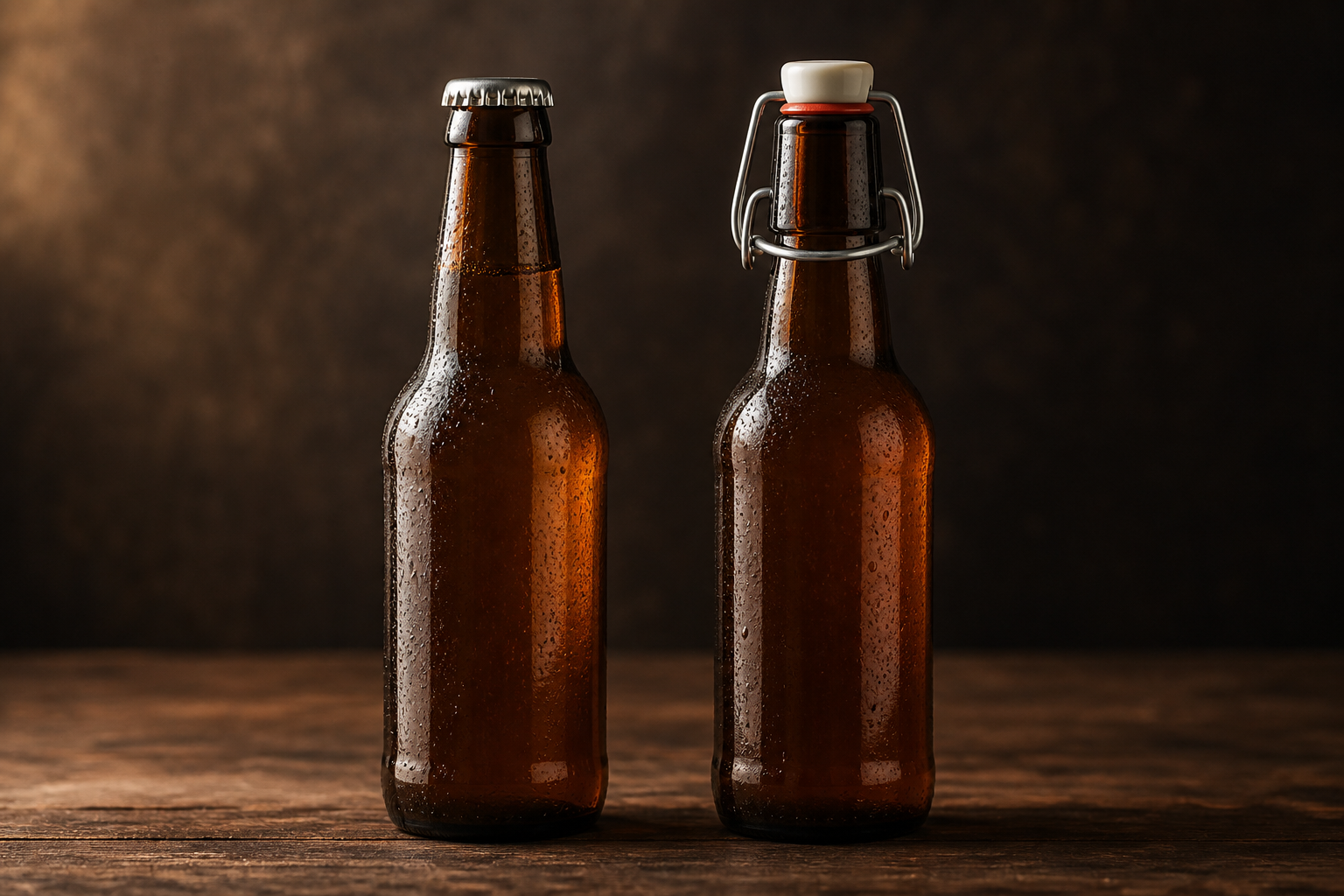
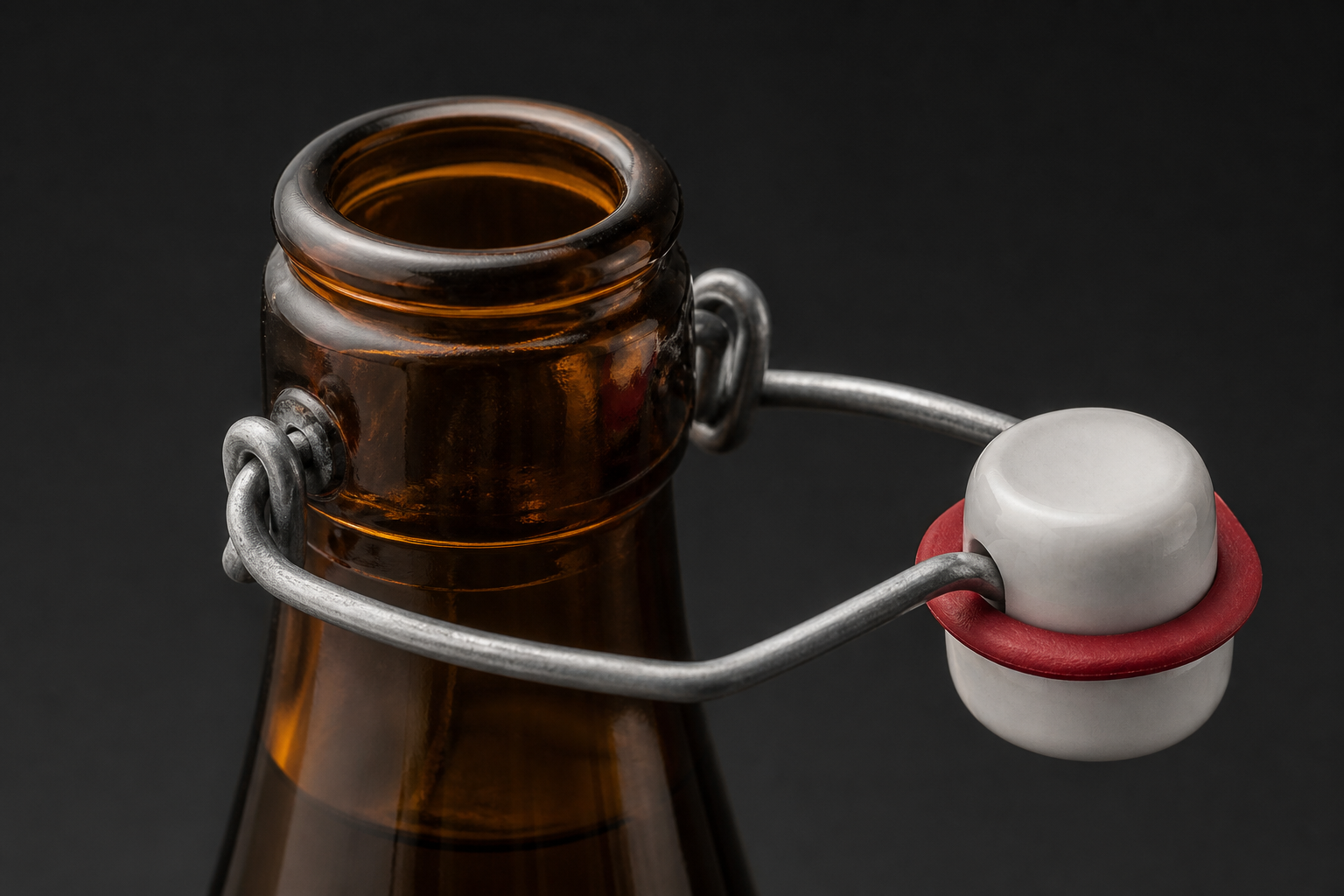
One is crimped metal, the other is spring-loaded ceramic — and the difference starts at the glass. A crown cap is a shallow metal cap with a compressible liner, crimped by machine around a standardized lip. The design came from William Painter, who received patents for his bottle sealing device in 1892; it could be applied mechanically and it held pressure without leaking, which is why it became the worldwide standard for beer[1]. The swing top predates it. Known in Germany as the Bügelverschluss, it was invented by Nicolai Fritzner in Berlin in 1875 and consists of a pivoting wire spring fastened by a collar crimped into the bottle’s neck, locking a porcelain cap and rubber gasket against the opening[2].
The important detail for a buyer is that collar. A swing top is not a cap you add to a bottle — it is a system the bottle must be built for. The wire bail anchors into a formed feature on the neck, which means the mold has to include it. A crown finish, by contrast, is a standardized lip: 26mm is the classic diameter for beer and soft drinks, while 29mm is used mainly above wine and champagne-style bottles[3]. If your bottle has a 26mm crown finish, any 26mm crown from any supplier will fit it. If your bottle does not have a swing-top collar, no swing top will fit it at any price.
Crown caps also come in two opening formats — pry-off, which needs an opener, and twist-off, which does not[3]. The two are not interchangeable on the same glass: a twist-off crown requires a threaded finish, so this is a decision that has to be made with the bottle, not after it.
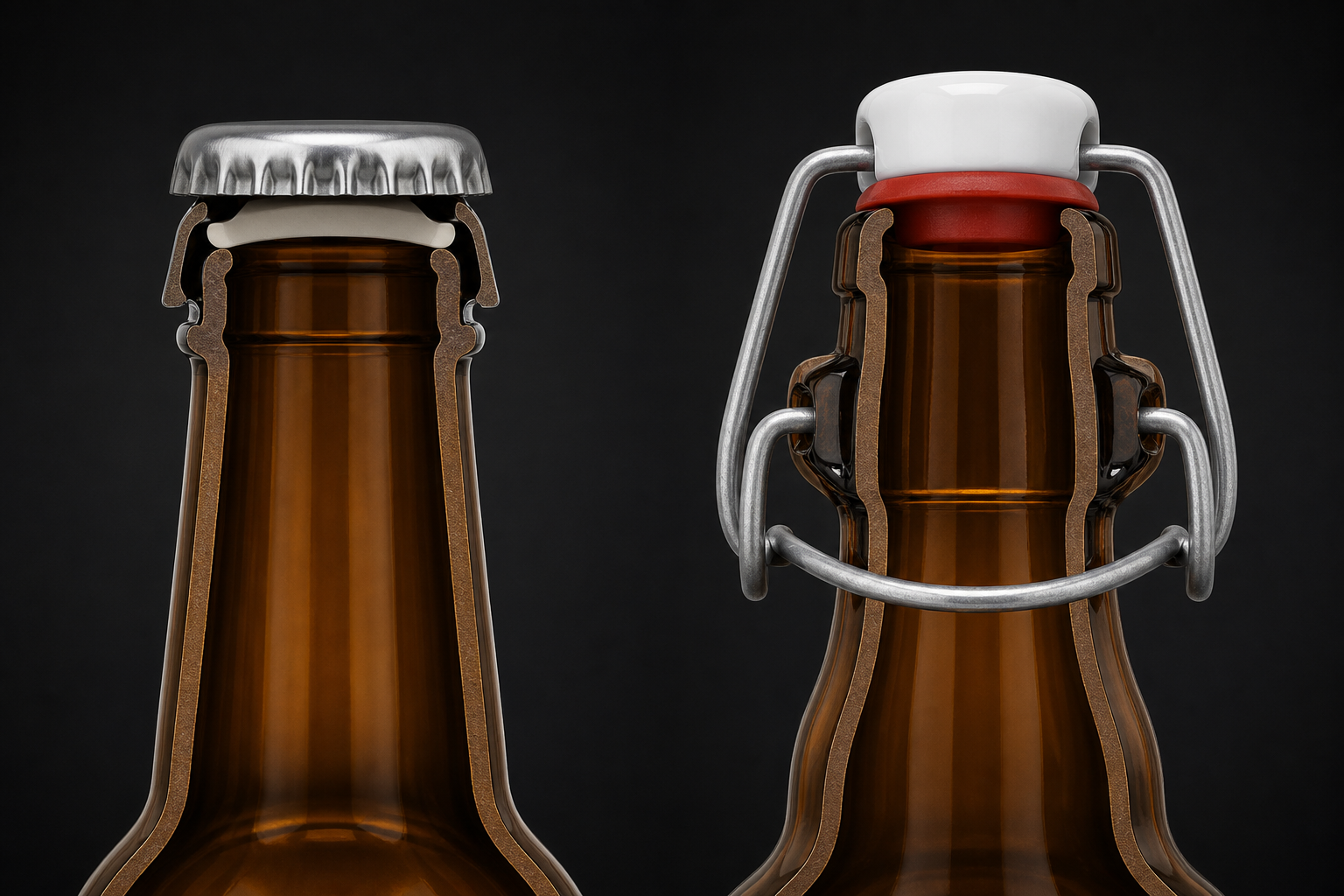
The two profiles above make the constraint visible: the crown finish is a standardized lip that any 26mm crown crimps onto, while the swing-top neck carries an additional collar that the wire bail hooks into. One is a stock item; the other is a mold decision.
Which closure protects the beer better?
For a sealed bottle going to retail, the crown cap has the clear technical advantage. The reason is the liner. A crown’s liner is a specifiable component: scavenger materials remove or reduce oxygen to delay oxidation and extend shelf life, and barrier materials limit the ingress of oxygen and other volatiles that would compromise the drink[3]. That is a meaningful lever for a hop-forward beer with a long distribution chain. A swing top’s seal is a rubber gasket, and a gasket is a mechanical part with a service life — it compresses, dries out, and eventually stops sealing.
This is not a modern criticism. The historical record is blunt about why the industry switched: swing tops were difficult to make and attach, and with the gasket materials of the era they often leaked[1]. Gasket compounds have improved enormously since then, and a well-made modern swing top seals carbonated beer perfectly well. But the failure mode still belongs to the consumer rather than the brewery: once the bottle leaves your warehouse, the seal depends on a part that ages, and on the drinker closing it properly.
A Glimpse into Glass History: Before Fritzner’s wire bale, beer was closed like champagne — a cork held down by wire or string cage. The swing top’s real innovation was not just containing pressure but making the bottle easy to reclose, which is exactly the property craft brands rediscovered a century later. The crown cap then displaced it by being cheaper and faster, not by sealing a fundamentally different way.
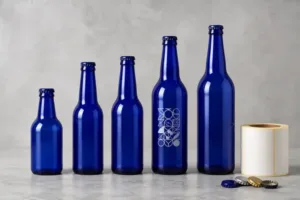
Light protection is a separate variable from closure choice, and it is worth deciding independently. Neither a crown cap nor a swing top does anything for the glass wall, which is where the lightstruck risk lives — our guide to blue beer bottle sizes, MOQ and UV protection covers how bottle color changes that calculation.
What does each closure mean for your filling line and your budget?
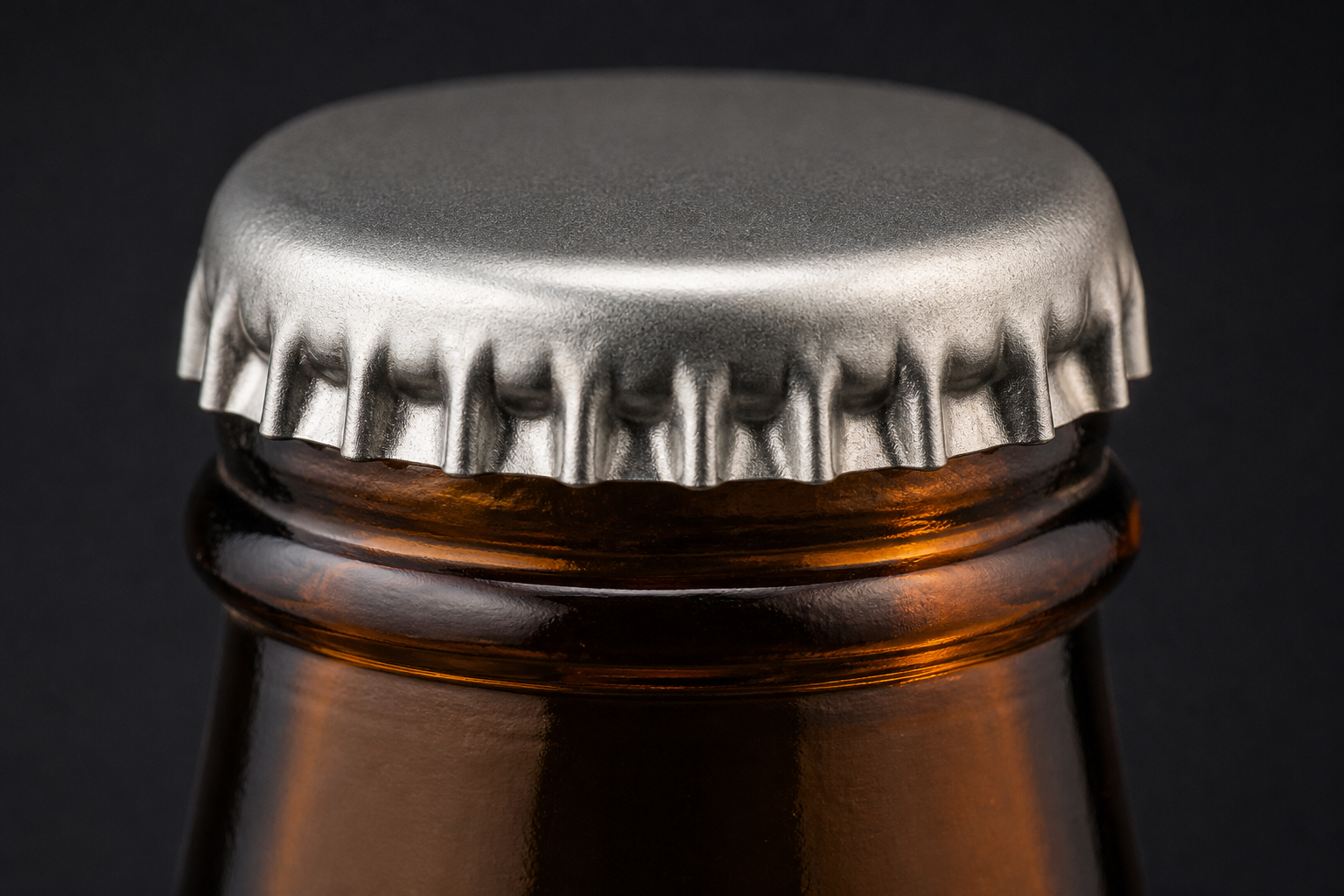
Crown capping is the default that every commercial line is built around; swing tops are not. A crowner is standard equipment, runs at high speed, and the closure itself is one of the cheapest components in the whole package. Swing tops invert that: the closure assembly costs several times more per unit than a crown, and the sealing step is mechanically different, so a line configured for crowning cannot simply switch. Small breweries often close swing tops by hand or semi-automatically, which is workable at low volume and a bottleneck at scale.
| Factor | Crown cap | Swing top |
|---|---|---|
| Bottle requirement | Standard 26mm crown finish | Neck collar formed in the mold |
| Sealing element | Specifiable liner (scavenger or barrier) | Rubber or silicone gasket |
| Reclosable | No | Yes, repeatedly |
| Filling line | Standard crowner, high speed | Dedicated or manual sealing |
| Closure cost per unit | Lowest of any beer closure | Several times higher |
| Best for | Retail SKUs, export, distribution | Taproom, gift packs, homebrew, refill programs |
The consumer-facing argument for swing tops is real, and it is not about sealing. It is about the moment of opening, the reusability of the bottle, and the perceived value of a package a drinker keeps rather than discards. For a taproom growler program, a limited gift release, or a brand whose whole story is craft heritage, that can justify the cost. For a 12-pack going through three distribution handoffs to a supermarket shelf, it rarely does.
Which closure can you actually order, and at what MOQ?
We will be direct about this, because it saves everyone a round of emails: our stock beer bottles are supplied with crown finishes. That covers the amber beer bottles in 250ml, 330ml and 640ml, the 330ml amber and colored range, and the 330ml cobalt blue bottle. Swing-top bottles are not a universal stock item, because the closure depends on a neck collar formed in the mold — so availability has to be confirmed against a specific bottle profile before you plan a program around it. If a swing top is central to your concept, tell us at the enquiry stage rather than after artwork, and we will tell you honestly whether it can be sourced from stock or needs a custom mold.
The MOQ consequence follows from that. A crown-finish bottle is a stock decision; a swing-top bottle may be a mold decision, and the two sit an order of magnitude apart.
| Route | Typical MOQ | Sampling → production |
|---|---|---|
| Stock crown-finish bottle, plain or silkscreened | 2,000 pcs | 7–10 days → 15–20 days |
| Stock bottle + hot stamping | 6,000 pcs | Quoted per artwork |
| Custom mold, flint glass | 100,000–200,000 pcs | 35–45 days → 40–50 days |
| Custom mold, melted color | 200,000–300,000 pcs | 35–45 days → 40–50 days |
Production time begins after sample approval and excludes ocean freight. The practical reading is that a crown-finish program can be on the water in about a month from artwork approval, while any closure that requires a new mold puts roughly three months in front of your launch date. You can see the current stock range and capacities on our Beer & Ale Bottles category page.
What do buyers get wrong about closures?
Two assumptions account for most of the wasted time in closure conversations. The first is that a swing top can be added to a bottle already chosen for its shape or color — it cannot, unless that bottle was molded with the collar. Buyers who fall in love with a stock bottle and then specify a swing top are effectively specifying a custom mold without realizing it, and the quantity and schedule change accordingly.
The second is that the closure is where light and oxygen protection is won. It is not. Oxygen ingress through a modern crown liner is manageable and specifiable; light damage happens through the glass wall, and no closure fixes it. Buyers who are genuinely worried about shelf life get further by choosing amber glass and an oxygen-scavenging liner than by upgrading the closure, and both of those are available on a stock bottle at 2,000 pieces.
The useful question to ask a supplier is a narrow one: does this exact bottle, in this exact capacity and color, exist with the finish I want, in stock, today? That single question resolves closure, MOQ, and lead time in one answer.
Conclusion: Crown for distribution, swing top for the experience
Crown caps won the commercial market on merit, and nothing about modern packaging has reversed that. They seal reliably under carbonation pressure, they run on equipment every co-packer already owns, their liners can be tuned for oxygen performance, and they are the cheapest closure in the category. If your beer is going into distribution, the crown cap is the default and the burden of proof sits with any alternative.
Swing tops earn their place where the bottle itself is part of the product experience — taproom fills, gift and seasonal releases, refill programs, and brands built on craft heritage. Just specify the closure at the same time as the bottle, not afterwards, because the wire bail is a mold feature and retrofitting it is not an option. Tell us your capacity, color, closure and target quantity and we will tell you which of these is available from stock and which needs tooling. Contact us at sales@glassypack.com or through our Contact Us page.
FAQ
Not for sealing performance. Crown caps hold carbonation reliably and their liners can be specified for oxygen scavenging or barrier function, which a rubber gasket cannot match. Swing tops are better when reclosability, reuse, and the opening experience are part of the product proposition.
26mm is the standard crown diameter for beer and soft drinks worldwide. 29mm crowns exist but are used mainly for wine and champagne-style bottles, including some Belgian and bottle-conditioned beer formats.
No. The wire bail anchors into a collar formed on the bottle neck during molding, so a bottle made for a crown finish cannot accept a swing top. The closure has to be decided at the same time as the bottle.
Our stock beer bottle range is supplied with crown finishes. Swing-top availability depends on the specific bottle profile, so it needs to be confirmed against your capacity, color and shape before ordering rather than assumed.
Pry-off crowns require an opener; twist-off crowns can be removed by hand. They are not interchangeable on the same glass, because a twist-off crown needs a threaded finish. Confirm which one your bottle drawing specifies before ordering caps.
The crown cap, by a wide margin. It is the lowest-cost closure in the beer category, while a swing top assembly of stopper, gasket and wire bail costs several times more per unit and adds labor if the line is not configured for it.
References
[1] Craft Beer & Brewing. (2012). Crown cap — The Oxford Companion to Beer. https://www.beerandbrewing.com/dictionary/OgmlWvHjQc
[2] Craft Beer & Brewing. (2012). Flip-top — The Oxford Companion to Beer. https://www.beerandbrewing.com/dictionary/E4AeQl2N60
[3] Pelliconi. (2022, January 27). The secret of the perfect closure: crown corks from A to Z. https://www.pelliconi.com/news/news/the-secret-of-the-perfect-closure-crown-corks-from-a-to-z/