Quick Answer: Blue beer bottles are a shelf-differentiation choice, not a complete light-protection choice. Cobalt blue glass absorbs ultraviolet but still transmits the 400–500 nm blue visible light that skunks beer, so amber remains the safest benchmark. Common sizes include 250ml, 330ml, 355ml and 500ml. MOQs run from 2,000 pieces for stock bottles to 300,000 for custom-melted color.
- Cobalt blue glass filters ultraviolet radiation but does not block blue visible light as effectively as amber glass.
- 330ml and 355ml are the dominant single-serve formats, with 250ml and 500ml as secondary stock sizes.
- Stock blue bottles start at 2,000 pieces; a custom mold in melted blue glass requires 200,000 pieces or more.
- A decorated stock bottle ships in about 22 days; a custom mold takes 75 to 95 days before the first pallet exists.
- Brewers using blue glass should pair it with light-stable hop extracts, opaque decoration, or closed secondary packaging.
Are blue beer bottles a practical packaging choice, or are they mainly a shelf-impact decision? For a brewery buyer, the answer depends on four connected variables: serving size, crown-finish compatibility, order quantity, and the beer’s sensitivity to light. Blue glass is a recurring request in craft beer packaging, but its protective performance is widely misunderstood. Buyers often assume that because a bottle is dark, it protects the beer inside. The physics say otherwise. This guide breaks down the sizes that are actually available, the honest minimum order quantity and lead time behind each sourcing route, and how much light protection cobalt blue glass does and does not deliver.
Which blue beer bottle sizes are most practical for breweries?
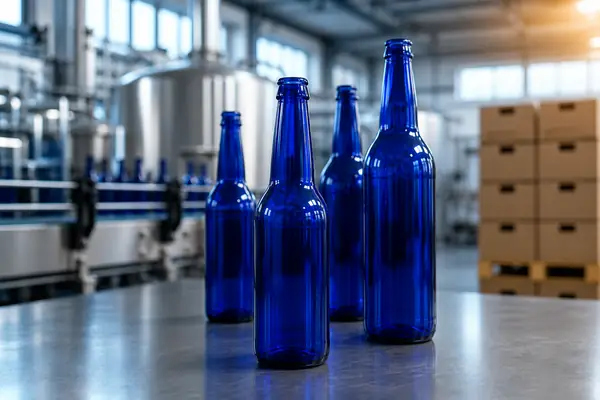
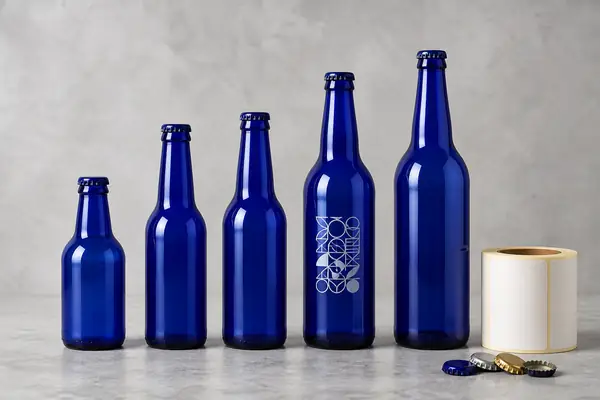
330ml and 355ml are the practical single-serve choices, with 500ml for a larger individual format and 650ml or 750ml for sharing. These map onto the capacities the beer industry already runs: 330ml and 250ml are the standard sizes in Europe, 12 US fl oz is the North American equivalent, 500ml is an established European pint format, and 22 oz / 650ml and 750ml serve as share sizes[4]. In blue glass specifically that list narrows: 330ml is the format most often held in stock, 250ml, 355ml and 500ml appear in some catalogs, and anything above 500ml is usually a custom project rather than a shelf item.
Neck finish matters as much as capacity. A 330ml blue bottle is normally supplied with a 26 mm crown finish, which keeps it compatible with standard crown capping equipment and with the pressures generated by typical beer carbonation levels. If you are planning a swing-top or a 29/25 ROPP closure instead, confirm the finish drawing before you confirm the color, because a finish change usually pushes the project into custom-mold territory. Our stock 330ml cobalt blue beer bottle is built around exactly this configuration: round body, crown finish, ready for silkscreen. Buyers comparing other shapes or capacities can review the broader Beer & Ale Bottles category before requesting drawings, crown dimensions and packing data.
| Capacity | Typical market | Availability in blue glass | Best use case |
|---|---|---|---|
| 250 ml | Europe, Asia, travel retail | Occasional stock item | Tasting flights, high-ABV formats, hot climates |
| 330 ml | Global standard | Widely available from stock | Core SKU, export cartons, on-trade listings |
| 355 ml | 12 US fl oz programs | Stock or custom, depending on plant | North American retail and distributor listings |
| 500 ml | Europe, emerging in the US | Limited stock, often custom | Draft-style pint formats, wheat and Belgian styles |
| 650–750 ml | Share and gift formats | Custom project only | Limited releases, cellar and gift packs |
Do blue beer bottles protect beer from UV light?
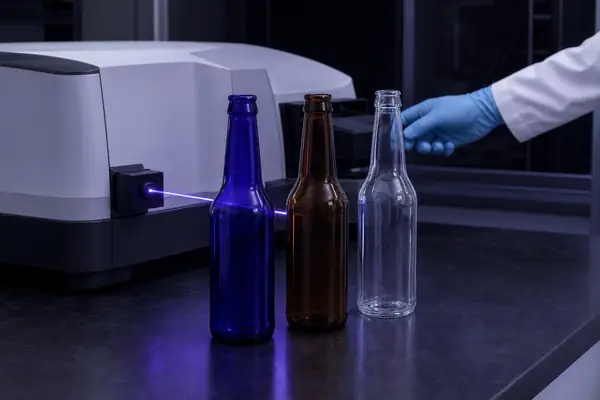
Partly, and not in the range that matters most. Lightstruck flavor is not caused by ultraviolet alone. Riboflavin in beer acts as a photosensitizer, and the blue part of the visible spectrum, roughly 350 to 500 nm, is the most efficient at generating the skunky compound MBT[3]. Research on beer photodegradation confirms that UV and visible light up to 500 nm drives the reactions that form 3-methylbut-2-ene-1-thiol, a compound with a sensory threshold of just 2–7 ng/L[1]. Cobalt blue glass absorbs ultraviolet, but by definition it transmits blue light — that transmission is what makes it look blue. The industry body for North American container glass puts it plainly: cobalt blue offers UV protection, but it does not filter blue light the way amber does[2].
Amber is the benchmark, and the gap is wide. Amber glass absorbs nearly all radiation below 450 nm, which is precisely why it became the default beer color[2]. Green and clear glass offer little to no meaningful protection against the lightstruck reaction, while brown glass is highly effective[3], and in practical terms cobalt blue sits closer to green than to amber. The speed of the reaction is what surprises most buyers: under strong sunlight, trained tasting panels can detect lightstruck aroma after less than ten seconds of exposure[3]. Under retail fluorescent or LED lighting the same chemistry runs quietly for days or weeks, which is the scenario that actually damages a brand.
A Glimpse into Glass History: Cobalt blue is one of the oldest deliberate colors in glassmaking. Eighteenth-century English glasshouses built an entire reputation on it, importing cobalt oxide from Saxony to produce the deep blue decanters and apothecary bottles still known as Bristol blue. Even then the color signaled value and contents worth protecting — the same instinct that puts blue glass on a premium beer shelf today.
The fix is engineering, not color. Brewers who commit to blue glass generally do one of three things. They switch to reduced or “light-stable” hop products such as tetra- and hexa-hydro iso-alpha acids, which are modified so they cannot degrade into MBT[3]. They restrict the beer to fast-turning channels where shelf exposure is measured in weeks, not months. Or they use decoration as a physical light barrier — heavy opaque ceramic coverage, a wrap label, or a closed carton. If you are taking the decoration route, the practical constraints are worth understanding before artwork is approved; our guide to screen printing on glass bottles covers ink adhesion, curing, registration and coverage limits on curved surfaces.
What is the real MOQ for a blue beer bottle order from China?
It depends entirely on whether the color already exists in the tank. Blue glass is produced by adding cobalt oxide, a colorant so powerful that only a few parts per million produce a visible tint[2]. The cost is not the cobalt — it is the production slot. Most colored container glass is melted in the tank itself, which means a color change consumes the furnace, generates out-of-specification glass during the transition, and can only be justified by a very large run. Some plants use forehearth coloring instead, adding colorant to the channel feeding the forming machine, which is how oxidized colors like blue can be produced in shorter campaigns[2]. That single technical distinction is the difference between a 2,000-piece order and a 300,000-piece order.
Four sourcing routes, and the gap between them is measured in both pieces and weeks. The first two rows below are the realistic entry points for a craft brewery; the last two are decisions usually reserved for a national brand or a large importer. Note that the lead-time column matters as much as the quantity column — a stock bottle with silkscreen can be sampled in a week and produced in about two, while a custom mold puts roughly three months between the purchase order and the first pallet.
| Sourcing route | Typical MOQ | Sampling → production | What you control |
|---|---|---|---|
| Stock blue bottle, plain or silkscreened | 2,000 pcs | 7 days → 15 days | Silkscreen artwork, ink colors, label |
| Stock blue bottle + hot stamping | 6,000 pcs | Quoted per artwork | Metallic foil placement and coverage |
| Custom mold, flint glass | 100,000–200,000 pcs | 35–45 days → 40–50 days | Shape, embossing, weight, finish |
| Custom mold, melted color | 200,000–300,000 pcs | 35–45 days → 40–50 days | Everything, including the exact blue |
Read the table as a decision tree, not a price list. If your first run is under six figures, the custom-mold rows are closed to you regardless of budget, and the question becomes which decoration method earns its 2,000- or 6,000-piece minimum. If you are above 200,000 pieces and committed to a proprietary shape in melted blue, the calendar becomes the binding constraint instead: sampling and production together consume 75 to 95 days before anything reaches a filling line, which has to be booked against a seasonal launch, not discovered after artwork is approved. Decoration, closures and cartons can each carry their own minimums, so always confirm which component sets the binding number.
Color consistency is the hidden risk at every tier. Blue is unforgiving: because cobalt is active at parts-per-million levels, small variations in batch composition or furnace conditions shift the shade visibly, and two pallets from different campaigns can look like two different products on the same shelf. This is why color variation belongs in the written inspection protocol, not in the “we’ll check on arrival” pile — the mechanics of colorimetric checking, annealing verification and dimensional testing are set out in our breakdown of quality control in glass bottle manufacturing. On the finished-bottle side, pressure and airtightness testing matter just as much for a carbonated product, and how we run those inspections explains what a batch report should contain. It is also worth agreeing, in writing, that a retained reference bottle from the first shipment becomes the color standard for every repeat order.
What does a real blue beer bottle inquiry look like?
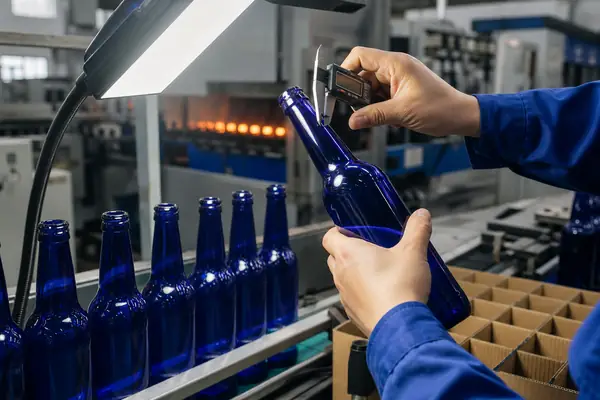
The quantity is rarely the real problem. The calendar is. A US brewer came to us with a summer season already committed and a supplier that had failed to deliver on time. They needed 50,000 blue bottles, and they needed them inside 20 days — otherwise the beer would miss the selling window it had been brewed for. At that point every custom route was already closed: 50,000 units sits below the volume at which a custom mold is viable, and even if it had cleared, mold sampling and production together consume 75 to 95 days. No amount of budget compresses that into three weeks.
What made the deadline achievable was the drawing they already had. We took their technical drawing and matched it against our stock range rather than treating it as a specification to be manufactured from scratch — the dimensions, capacity and crown finish lined up closely with a classic 330ml cobalt blue bottle we hold in inventory. Once the buyer confirmed the substitution against their filling line and their existing labels, there was nothing left to produce. The bottles shipped within a week, the beer made its summer window, and the total elapsed time from first inquiry to dispatch was shorter than the sampling stage alone on a custom mold.
The lesson generalizes beyond emergencies. Before commissioning anything, it is worth asking a supplier to check your drawing against what already exists on their shelves. A stock bottle that matches your dimensions within tolerance removes the mold cost, removes the 75-to-95-day schedule, and removes the risk of a first article arriving wrong. Decoration can be added later once volumes justify it — silkscreen from 2,000 pieces, hot stamping from 6,000 — which lets the brand build its shelf identity in stages rather than betting a season on a single custom run.
Conclusion: Buy blue for the shelf, engineer around the light
Blue beer bottles earn their place on a premium shelf, and there is nothing wrong with choosing one for that reason — as long as the decision is made with open eyes. Cobalt blue is a branding instrument first and a light filter second. Treat the color as a marketing asset, and then protect the beer separately through hop chemistry, decoration coverage, secondary packaging and honest shelf-life expectations. On the procurement side, the single most useful question to ask any supplier is whether the blue comes from stock, from the forehearth, or from the tank, because that answer determines whether your minimum order is two thousand pieces or three hundred thousand — and whether your first pallet arrives in three weeks or three months.
If you are weighing blue against amber for a new SKU, or trying to find out whether your target volume clears the color MOQ, we are glad to work through the numbers with you before any artwork is committed. Contact us at sales@glassypack.com or visit our Contact Us page to discuss your specification.
FAQ
They are not inert, but they are not as protective as amber. Cobalt blue glass transmits blue visible light in the 400–500 nm band that drives the lightstruck reaction, so beer in blue bottles is more vulnerable than beer in amber. It is a workable choice for fast-moving products, light-stable hop formulations, or heavily decorated bottles.
330 ml is the standard, and it is the size most commonly held in stock in cobalt blue. 250 ml, 355 ml and 500 ml are available from some suppliers, while 650 ml and 750 ml share formats are generally custom projects rather than catalog items.
Because the color is created in the melt, not applied afterwards. Changing the color of a furnace takes the tank out of production and generates off-specification glass during the transition, so the cost can only be absorbed by very large runs. Stock colors and forehearth-colored glass avoid this, which is why a stock blue bottle starts at 2,000 pieces while a custom melted color starts at 200,000.
Rarely. A custom mold in flint glass typically starts at 100,000 to 200,000 pieces, and adding a melted color pushes the requirement to 200,000 to 300,000. Most brands achieve a distinctive look at low volume by decorating a stock blue bottle instead, which starts at 2,000 pieces.
A stock blue bottle with silkscreen decoration is normally sampled in about 7 days and produced in about 15, so roughly three weeks from approved artwork. A custom mold is a different order of magnitude: 35 to 45 days for sampling and a further 40 to 50 days for production, or roughly three months before the first pallet exists.
Fix a physical reference bottle from your first approved shipment and write it into the purchase specification as the color standard. Ask the supplier to record the production campaign and to run colorimetric checks against that reference, and schedule repeat orders within the same campaign wherever volumes allow.
Amber is better for the beer; blue is better for shelf differentiation. If the product is hop-forward, exported, or expected to sit on a lit retail shelf for months, amber is the lower-risk choice. If the beer is fast-moving, brewed with light-stable hop extracts, or heavily decorated, blue becomes a defensible option.
References
[1] Pratap-Singh, A. et al. (2023). Effect of UV Filters during the Application of Pulsed Light to Reduce Lactobacillus brevis Contamination and 3-Methylbut-2-ene-1-thiol Formation. Foods, 12(4), 684. https://pmc.ncbi.nlm.nih.gov/articles/PMC9955924/
[2] Glass Packaging Institute. Glass Coloring. https://www.gpi.org/glass-coloring
[3] Craft Beer & Brewing. (2012). Lightstruck — The Oxford Companion to Beer. https://www.beerandbrewing.com/dictionary/eIXf22Zwnt
[4] O-I Glass. (2019, February 7). Beer packaging: choosing the right bottle for your beer — Part I. https://glass-catalog.com/fr-en/news/beer-packaging-choosing-the-right-bottle-for-your-beer-part-i