Quick Answer: Most dairy and plant-based brands choose 250ml or 300ml glass bottles for single servings, 500ml for standard retail and 1 litre for family and home delivery. In the US, the nearest sizes are 8oz, 16oz (pint), 32oz (quart) and half gallon. In the UK, milk in returnable bottles can still be sold by the pint (568ml).
- 250ml to 300ml glass milk bottles suit single servings, cafes, schools and flavoured milk.
- 500ml and 1 litre are the standard retail and home delivery sizes in metric markets.
- A US quart is 946ml and a half gallon 1.89 litres, so US brands need to plan for different volumes.
- The UK still allows milk in returnable containers to be sold by the imperial pint.
Are you choosing a milk bottle size by habit, or by where your milk will actually be sold? The same 500ml bottle that sells well in a European supermarket can look odd on a US shelf, where shoppers think in pints, quarts and half gallons. This guide compares the common glass milk bottle sizes in metric, US and UK units, shows which size fits which sales channel, and explains how lids, filling and branding affect the choice.
Why does milk bottle size depend on your market?
Milk bottle size depends first on the units your customers use. Most of the world buys milk in metric sizes such as 250ml, 500ml and 1 litre, while the United States uses customary units and the United Kingdom keeps a special exception for the pint.
In the US, milk is sold in pints, quarts, half gallons and gallons. A US pint is 473ml, a quart 946ml and a half gallon 1.89 litres. A brand that launches in both Europe and the US therefore often needs two bottle sizes, or one size labelled in both units.
In the UK, packaged goods must normally be sold in metric units, but milk in returnable containers is one of the few products that can still be sold by the pint[1]. That is why the classic doorstep milk bottle holds one imperial pint, or 568ml, rather than 500ml.
How big is the market for milk in glass bottles?
Milk in glass bottles is a small but active market, driven mainly by doorstep delivery, premium dairies and plant-based brands. In the UK, Milk & More makes around 600,000 deliveries of milk and groceries to more than 250,000 customers a week[2], and the same report notes that Cotteswold Dairy had shifted 39 million glass bottles in 2026 by the time of writing.
Returnable systems also change how a bottle should be specified. Some UK delivery services report that their glass bottles are washed and reused up to 25 times on average, so wall strength and a consistent neck finish matter as much as capacity.
What are the standard glass milk bottle sizes?
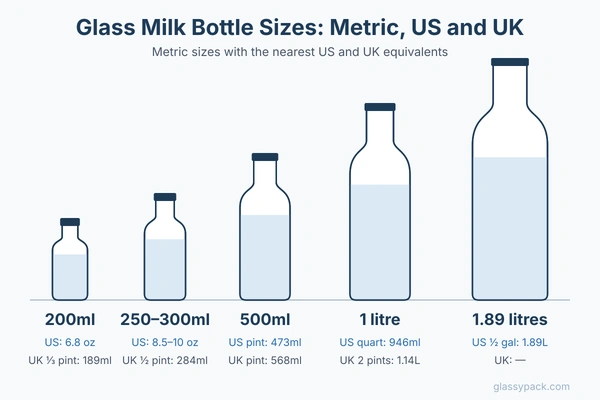
The standard glass milk bottle sizes fall into four groups: small single servings, standard retail, large family and food service. The table below compares metric, US and UK equivalents so you can match your bottle to your market.
| Group | Metric | US equivalent | UK equivalent | Typical use |
|---|---|---|---|---|
| Mini | 100ml to 200ml | 3.4oz to 6.8oz | Third pint (189ml) | Yogurt drinks, coffee creamer, school milk, samples |
| Single serve | 250ml to 300ml | 8.5oz to 10oz | Half pint (284ml) | Flavoured milk, cafes, grab-and-go |
| Standard retail | 500ml | 16oz pint (473ml) | Pint (568ml) | Supermarket and doorstep delivery |
| Family | 1 litre | 32oz quart (946ml) | 2 pints (1.14L) | Household milk, plant-based milk |
| Large | About 1.9 litres | Half gallon (1.89L) | — | US farm dairies and food service |
Our own glass milk bottles run from 200ml to 1000ml, with small 100ml to 300ml jars for yogurt and pudding, which covers the mini to family groups above.
Which milk bottle size works best for each sales channel?
The best milk bottle size is the one that matches how often your customer buys and how they carry the product home. Daily or weekly buyers prefer smaller bottles that stay fresh, while family shoppers and food service want fewer, larger bottles.
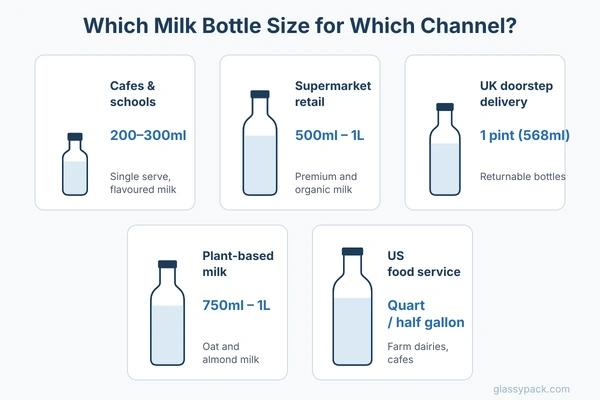
- Cafes, schools and convenience stores: 200ml to 300ml. Easy to hold, finished in one sitting, and good for flavoured milk and milk tea. See our 200ml to 500ml milk and dairy bottles.
- Supermarkets and premium retail: 500ml and 1 litre. The 500ml bottle suits premium and organic milk, where shoppers pay more per litre and finish the bottle quickly.
- Doorstep delivery: 1 pint (568ml) in the UK, 500ml or 1 litre elsewhere. Returnable systems favour a single standard size that crates and washes easily.
- Plant-based milk: 750ml to 1 litre. Oat and almond milk are used in coffee and cereal, so households buy them in larger bottles.
- Food service and farm shops in the US: quart and half gallon, where customers expect US sizes.
The first widely known glass milk bottle in the United States, Hervey Thatcher’s “Common Sense Milk Jar”, appeared in the 1880s and helped move milk away from being ladled from open cans into customers’ own jugs.
What trade-offs come with larger glass milk bottles?
Larger glass milk bottles lower the packaging cost per litre but add weight and shorten the time the milk stays fresh once opened. A 1 litre glass bottle filled with milk weighs well over a kilo, which matters for doorstep crates, shelf loading and shipping.
Freshness is the second trade-off. Fresh milk is usually consumed within a few days of opening, so a household that drinks little milk will waste more from a large bottle. That is one reason premium dairies often launch in 500ml before adding a 1 litre size.
The third trade-off is filling. Changing bottle size can mean changing filler settings, crates and labels, so it is worth confirming the size before you invest in custom labels or a custom mold.
Is the bottle capacity the same as the fill volume?
No. The capacity listed for a glass bottle is usually its brim-full volume, while the fill volume is the amount of milk you actually put in, which is lower. The gap between the two is the headspace, and it gives room for the lid, for foaming during filling and for the milk to expand slightly as it warms.
This matters most when you print the volume on the label. If you want to sell exactly 500ml of milk, you may need a bottle with a brim-full capacity a little above 500ml, depending on your filler and how high you fill. The same applies to a UK pint: a bottle sold as one pint needs to hold 568ml at the fill line, not at the brim.
What should you check before ordering glass milk bottles?
Before you place a bulk order, check five points that decide whether the bottle will run smoothly on your line and sell well on the shelf.
- Fill volume: run a fill test with your own milk to confirm the bottle reaches your labelled volume at your fill line.
- Lids and capping: confirm the neck finish matches the lids and capping equipment you already use.
- Crates and shelves: check that the bottle height and diameter fit your delivery crates, fridges and retail shelves.
- Labels and printing: decide early between paper labels and screen printing, because printing area depends on the bottle shape.
- Market units: make sure the size and the label units match the market you are selling to, especially if you sell in both metric and US or UK markets.
How do lids and neck finishes affect your choice?
Your lid choice should be fixed together with your bottle size, because the neck finish decides which caps, filling heads and cappers you can use. A bottle that fits your filling line saves more money than a slightly cheaper bottle that needs new equipment.
When you send an enquiry, tell us your filling method and which lids your line already uses, and we will suggest bottles that fit. For a wider comparison of packaging materials, see our article on glass vs plastic bottles for milk.
How can you brand a stock milk bottle without a custom mold?
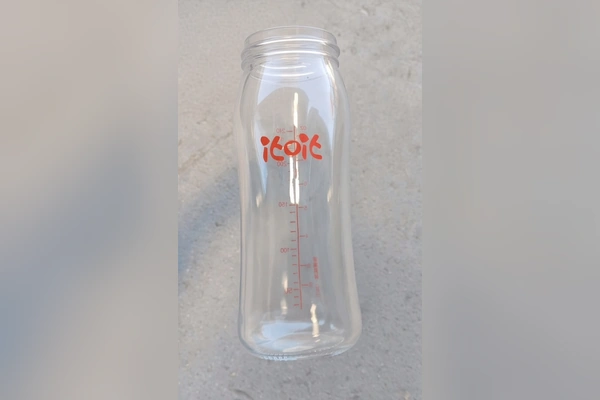
You can brand a stock glass milk bottle with screen printing, frosting or colour spraying, without paying for a custom mold. These decoration processes can be applied to any of our bottles, and a printed logo on a classic milk bottle shape is often enough to give a dairy brand a recognisable look. Screen printing can also add a measurement scale or other markings to the glass.
| Stock bottle | Custom mold | |
|---|---|---|
| Minimum order | 2,000 pieces | 30,000 to 50,000 pieces |
| Sampling time | 7 to 15 days (with your logo) | 35 to 45 days |
| Production time | 15 to 25 days (with your logo) | 35 to 45 days |
| Best for | New dairy and plant-based brands, trial runs | High-volume brands needing an exclusive shape |
How did we brand 5,000 milk bottles for a Dutch buyer?
A buyer from the Netherlands contacted us about glass milk bottles for an order of 5,000 pieces. That quantity is well below the 30,000 to 50,000 pieces needed for a custom mold, so we supplied one of our existing stock milk bottles and screen printed the buyer’s logo on the glass in food-grade ink.
This gave the buyer a branded bottle without mold costs or a long mold lead time, and 5,000 pieces is well above our 2,000-piece minimum for stock bottles. For many new dairy and plant-based brands, a stock bottle with a screen-printed logo is the most practical way to launch, and a custom shape can follow once volumes grow.
Conclusion
Choose your glass milk bottle size by market and sales channel first, then confirm lids and filling. For most brands, that means 250ml to 300ml for single servings, 500ml for retail and 1 litre for families, with US pints, quarts and half gallons or UK pints where your customers expect them. If you are planning a new milk or plant-based drink, send us your target market, capacity and quantity through our contact page, and we will suggest stock bottles that fit.
FAQ
What is the most common glass milk bottle size?
In metric markets, 500ml and 1 litre are the most common retail sizes. In the UK doorstep market the classic size is one imperial pint (568ml), and in the US it is the quart and half gallon.
How many ml is a US half gallon milk bottle?
A US half gallon is 64 US fluid ounces, or about 1.89 litres (1,893ml).
Why are UK milk bottles 568ml and not 500ml?
UK law still allows milk in returnable containers to be sold by the imperial pint, which is 568ml. Most other packaged goods must be sold in metric units.
What size glass bottle is best for flavoured milk?
Flavoured milk is usually sold in 250ml to 300ml bottles, which are finished in one sitting and suit cafes, schools and convenience stores.
What size glass bottle is best for oat or almond milk?
Plant-based milks are usually sold in 750ml to 1 litre bottles, because households use them daily in coffee and cereal.
Can I print my logo on a stock glass milk bottle?
Yes. Stock milk bottles can be screen printed with your logo from 2,000 pieces, with 7 to 15 days for sampling and 15 to 25 days for production.
References:
[1] GOV.UK. “Weights and measures: the law.” https://www.gov.uk/weights-measures-and-packaging-the-law
[2] The Grocer. “DTC dairy still delivers in the post-Covid era.” 2026. https://www.thegrocer.co.uk/analysis-and-features/dtc-dairy-still-delivers-in-the-post-covid-era/723602.article