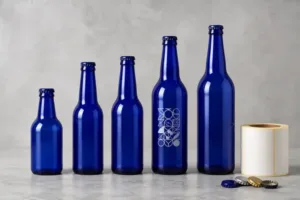
Is your premium olive oil or specialty vinegar losing its flavor, color, and nutritional value on retail shelves due to a poor choice of glass container?
For producers of extra virgin olive oil, gourmet seed oils, aged balsamic vinegars, and specialty dressings, the glass bottle is far more than a container — it is a preservation system. High-quality liquid condiments are highly sensitive to environmental factors. Exposure to light, oxygen, and poor sealing can trigger oxidation, leading to rancidity, off-flavors, and rapid degradation of active antioxidants.
To maintain the premium quality that consumers expect, food brands must understand the science of light protection, the engineering of drip-free pourers, and the specific bottle geometries that optimize both retail shelf space and automated bottling line efficiency. This comprehensive B2B sourcing guide explores the technical parameters of oil and vinegar glass packaging, comparing standard bottle profiles, explaining light-blocking glass formulations, and providing actionable procurement advice for commercial food brands.
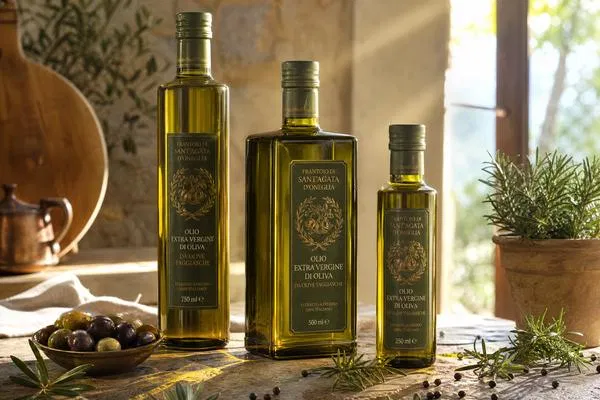
The Science of Light Protection: Why Bottle Color Matters
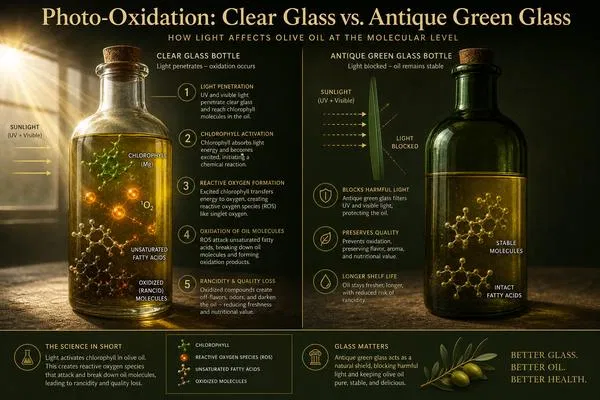
To understand why bottle color is critical, we must examine the chemistry of oil spoilage. Extra virgin olive oil is packed with chlorophyll and pheophytin — natural pigments that give the oil its beautiful green hue. However, these pigments are also photosensitizers. When exposed to light (particularly ultraviolet radiation and blue visible light), chlorophyll acts as a catalyst, absorbing light energy and transferring it to oxygen molecules. This creates highly reactive singlet oxygen, which rapidly oxidizes unsaturated fatty acids, destroying the oil’s delicate flavor compounds and degrading healthy antioxidants like Vitamin E.
This process, known as photo-oxidation, can render a premium oil rancid within weeks if stored in clear glass under retail fluorescent lighting. Studies show that extra virgin olive oil stored in clear glass loses up to 40% of its polyphenol antioxidants within just 30 days of retail shelf exposure, compared to less than 5% loss in antique green glass under the same conditions. To prevent this, commercial oil producers rely on three primary colored glass formulations.
Antique Green (Dead Leaf Green) is the classic choice, blocking over 90% of harmful UV and blue light wavelengths. It is the industry standard for extra virgin olive oil and has been for centuries. Amber Glass offers the highest level of photochemical protection, blocking up to 99% of light wavelengths under 450nm, making it ideal for high-value specialty oils and light-sensitive vinegars. Clear (Flint) Glass provides zero light protection but is preferred for highly stable products like distilled white vinegars, light seed oils, or dressings where showcasing the vibrant natural color of the product is the primary marketing goal.
“The origin of the classic green olive oil bottle is a story of accidental preservation. In the 18th and 19th centuries, glass blowers utilized raw sand that naturally contained high levels of iron impurities. This iron caused the molten glass to turn varying shades of forest green and amber. While early producers initially viewed this as a manufacturing defect, merchants quickly noticed that olive oil shipped in green bottles arrived at distant ports tasting fresh, while oil in rare clear glass bottles arrived rancid. What began as an impurity became the global hallmark of olive oil quality.”
Beyond light protection, glass is the ultimate material for acid resistance. Vinegars contain acetic acid, which can slowly corrode plastic PET containers or metal linings over time, leading to chemical leaching and flavor alteration. Glass is chemically inert, meaning it will never react with highly acidic vinegars or organic oils, ensuring 100% product purity and a stable shelf life.
Bottle Geometries: Dorica vs. Marasca and the PP31.5 Neck Standard
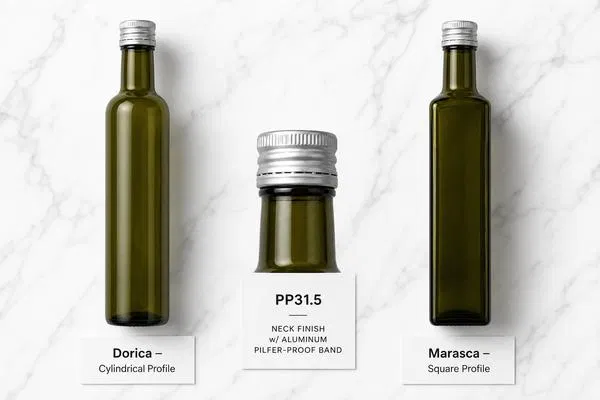
When sourcing glass bottles for oils and vinegars, two iconic Italian bottle geometries dominate the global market: the Dorica and the Marasca. Understanding the structural and logistical differences between these two profiles is essential for procurement managers optimizing both brand presentation and supply chain efficiency.
The Dorica Bottle
The Dorica is a tall, slender, cylindrical glass bottle. Its smooth, rounded profile offers a modern, elegant aesthetic that is highly favored by premium extra virgin olive oil and gourmet balsamic brands. The cylindrical shape provides a large, continuous surface area for wrap-around labeling, making it highly versatile for brand designers who want maximum label real estate. The Dorica’s flowing silhouette also photographs beautifully, making it a natural choice for brands with a strong social media and e-commerce presence.
The Marasca Bottle
The Marasca is a tall, square-profile bottle with sharp, clean lines. From a logistical standpoint, the Marasca is highly efficient. The square shape allows the bottles to pack tightly together in shipping cartons and on retail shelves, minimizing wasted space and reducing shipping costs per unit. The flat panels also provide a distinct, traditional look and prevent the bottles from rolling on automated conveyor belts during the filling process — a practical advantage that reduces line jams and breakage rates.
The PP31.5 Neck Standard
For both Dorica and Marasca bottles, the industry standard neck finish is the PP31.5 (Pilfer-Proof 31.5mm). This specific neck finish is engineered for aluminum roll-on pilfer-proof (ROPP) caps. When the metal cap is applied and crimped onto the PP31.5 neck, a metal band at the bottom of the cap locks beneath a glass ridge on the bottle neck. When the consumer twists the cap open for the first time, the perforated band breaks cleanly, providing a highly secure, tamper-evident seal that is mandatory for commercial retail distribution. The broken band signals to the consumer that the product has not been opened since leaving the factory — a critical trust signal for premium food products.
Closure Engineering: Drip-Free Pourers and Bottling Line Compatibility
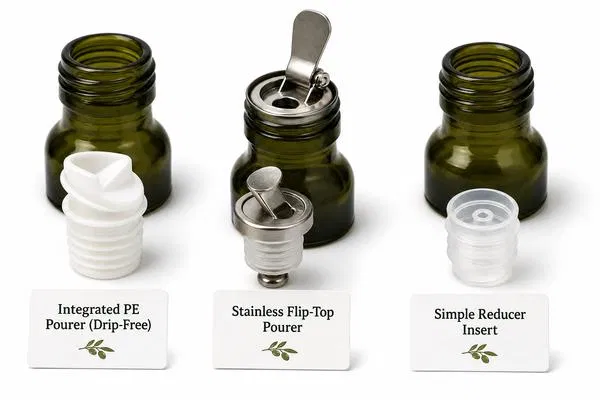
For liquid condiments like oil and vinegar, the consumer experience is defined by the pour. Oils are viscous and greasy; vinegars are highly liquid and stain-prone. A poor closure design leads to oil running down the side of the bottle, ruining the label, creating sticky kitchen counters, and frustrating consumers. To solve this, commercial oil and vinegar bottles utilize specialized pourer inserts. The table below compares the three primary pourer closure systems used in B2B packaging:
| Pourer Type | Material & Mechanism | Drip Prevention | Best Applications | Sourcing Notes |
|---|---|---|---|---|
| Integrated PE Pourer (Guala Style) | Food-grade PE insert with a sharp, dual-lip pouring edge that cuts the liquid flow instantly when tilted back upright. | Excellent. Complete drip prevention; slow, controlled stream. | Extra virgin olive oil, premium balsamic vinegars. | Requires a specialized capping machine chuck to press the insert into the glass neck. Must be sourced matched to the bottle’s neck ID. |
| Weighted Metal Flip-Top Pourer | Stainless steel spout with a gravity-activated weighted metal flap that opens automatically when tilted and closes when upright. | Good. Smooth, continuous stream; automatic closure prevents dust and insects. | Restaurant tabletop bottles, high-use kitchen oils. | Typically sold as a premium accessory; higher cost per unit. Not suitable for high-speed automated capping lines. |
| Simple PE Reducer Insert | Basic PE plug with a small central orifice to restrict flow volume. | Moderate. Restricts flow volume but does not completely prevent drips on the glass rim. | Table vinegars, soy sauces, thin salad dressings. | Low cost; easy to integrate on standard capping lines. Widely available. |
For automated bottling lines, B2B buyers must ensure that the glass bottle’s neck inner diameter (ID) is manufactured to tight tolerances — typically ±0.2mm. If the inner neck is too narrow, plastic pourer inserts will split or fail to seat completely; if too wide, the inserts can fall out when the consumer pours the product. Sourcing matched bottle-and-pourer sets from a single manufacturer eliminates these compatibility risks and simplifies quality control documentation.
Sourcing Strategy: Optimizing Your Oil and Vinegar Packaging
To maximize supply chain efficiency and minimize packaging defects, procurement managers should implement three strategic sourcing practices. First, always purchase your glass bottles, plastic pourer inserts, and aluminum ROPP caps from a single supplier. This ensures that the glass PP31.5 neck finish, the PE insert, and the aluminum cap are engineered to fit together perfectly, eliminating leakage and line-jamming risks. Second, ensure the manufacturer provides food grade certificates for both the glass bottle and the plastic pourer insert, confirming that no harmful plasticizers or heavy metals will leach into your product. Third, due to the height of Dorica and Marasca bottles, ensure your supplier uses heavy-duty, double-wall corrugated cartons with integrated dividers to prevent glass-on-glass friction and breakage during long-distance ocean freight.
Conclusion: Preserving Premium Taste from Factory to Table
In the gourmet food market, packaging is the bridge between your product’s craftsmanship and the consumer’s sensory experience. Sourcing the right glass cooking oil and vinegar bottles is a critical business decision that directly impacts product shelf life, brand perception, and consumer satisfaction. By choosing the protective properties of Antique Green or Amber glass, selecting the ideal bottle geometry for your brand and logistics, and pairing it with a high-performance drip-free pourer, you safeguard your liquid gold and elevate your brand’s presence in the marketplace.
The right bottle does not just hold your product — it protects your promise of quality.
Ready to elevate your oil or vinegar brand with premium glass packaging? Contact the sourcing experts at GlassyPack to request our Dorica and Marasca catalog, matched drip-free pourer samples, and compliance documentation. Reach us at sales@glassypack.com or visit our Contact Us page.
[1] The Role of Packaging Materials in Preserving the Chemical and Sensory Quality of Extra Virgin Olive Oil, Food Packaging and Preservation Journal, Vol. 52, No. 3, 2024.
[2] Photo-Oxidation Kinetics of Chlorophyll-Rich Vegetable Oils in Colored Glass Containers, Journal of Agricultural and Food Chemistry, 2025.
[3] Comparative Study of Light-Induced Oxidation of Olive Oil in Clear, Green, and Amber Glass Bottles, Food Chemistry, Vol. 398, 2024.
[4] Chemical Compatibility and Migration Studies of Acetic Acid in PET vs. Inert Glass Packaging, Food Additives & Contaminants, Vol. 41, No. 1, 2025.
[5] Standardization of PP31.5 Neck Finishes and Roll-On Pilfer-Proof (ROPP) Closures for Liquid Condiments, Glass Container Manufacturers Institute (GCMI) Technical Bulletin, 2025.
[6] Engineering Drip-Free Pouring Mechanisms for Viscous Condiments: Fluid Dynamics and Surface Tension Control, Journal of Food Engineering, Vol. 115, 2024.