For manufacturers of high-end vitamins, probiotics, organic herbal supplements, and pharmaceuticals, product efficacy is the foundation of brand trust. Yet many brands overlook a critical variable in their supply chain: the chemical and physical protective capabilities of their packaging. As the global wellness market shifts toward clean-label formulas, active organic compounds, and living probiotics, traditional plastic packaging is falling short.
Plastic containers, while lightweight, are highly permeable to oxygen and moisture, and offer limited protection against light-induced degradation. To safeguard sensitive active ingredients, premium wellness and pharmaceutical brands are upgrading to amber glass packaging. This comprehensive B2B sourcing guide explores the material science of amber glass, the engineering of child-resistant and tamper-evident closures, and the critical technical specifications required for high-speed automated bottling lines.
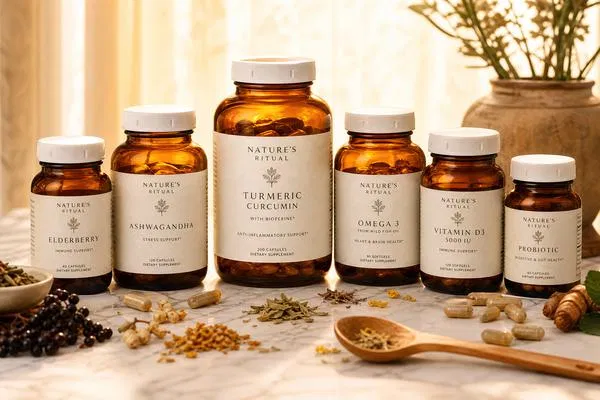
The Science of Amber Glass: Why Active Ingredients Demand Photochemical Protection
To understand why amber glass is the gold standard for pharmaceutical and supplement packaging, we must examine the physics of light. Light is composed of electromagnetic radiation of varying wavelengths. While visible light allows us to see, ultraviolet (UV) light (wavelengths between 10nm and 400nm) and blue visible light (400nm to 500nm) possess high photon energy. When these high-energy wavelengths penetrate a packaging container, they trigger photochemical reactions in sensitive organic compounds — a process known as photodegradation.
Photodegradation manifests in three critical ways for supplement and pharmaceutical products. First, it causes loss of potency: vitamins such as Riboflavin (B2), Vitamin C, and Vitamin B12 degrade rapidly when exposed to UV light, with studies showing potency losses of up to 47% in clear glass containers after just 72 hours of fluorescent light exposure. Second, it causes probiotic mortality, as living probiotic strains are highly sensitive to both light and the heat generated by infrared radiation. Third, it triggers chemical instability — light exposure causes oxidation that alters the color, smell, and chemical safety of pharmaceutical capsules.
“The protective power of amber glass was first utilized on a commercial scale in Europe during the mid-19th century. Early apothecaries and pharmacists discovered that expensive liquid medicines and botanical oils spoiled within weeks when stored in clear glass bottles, but remained potent for years when kept in dark amber jars. By the 1870s, amber glass had become the universal symbol of pharmaceutical quality and safety across the globe.”
Amber glass is uniquely engineered to solve this problem. During the glass melting process, iron, sulfur, and carbon are added to the silica batch. These elements alter the molecular structure of the glass, allowing it to absorb and block light waves. Specifically, high-quality amber glass absorbs 99% of all ultraviolet radiation and blue light wavelengths under 450nm, creating a complete protective shield for the active molecules inside.
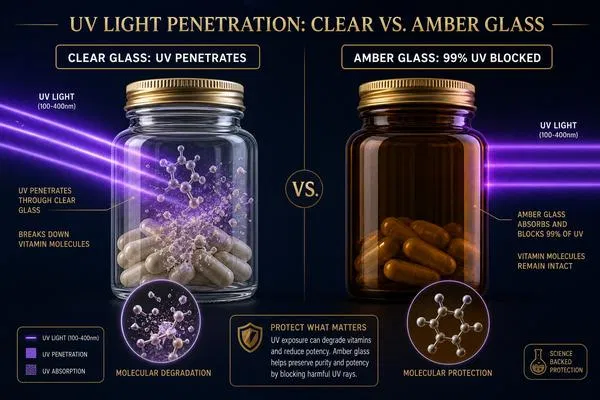
Beyond light protection, glass offers unmatched barrier properties compared to plastics like PET (polyethylene terephthalate) or HDPE (high-density polyethylene). Glass is virtually impermeable to gases and moisture, preventing oxygen from seeping in and oxidizing dry capsules, while keeping ambient humidity out — a critical factor for effervescent tablets and moisture-sensitive probiotic powders. Furthermore, glass is chemically inert: it does not leach harmful chemicals such as phthalates or antimony into the product, ensuring 100% formula purity throughout the product’s shelf life.
Safety and Compliance: Child-Resistant Caps and Tamper-Evident Seals
In the pharmaceutical and supplement industries, packaging is heavily regulated to protect public health. For B2B buyers, sourcing compliant closures is just as critical as sourcing high-quality glass jars.
Child-Resistant Closures (CRC)
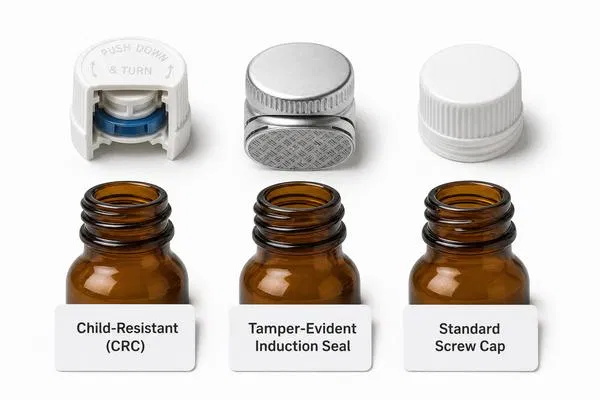
Under international standards — including the US Poison Prevention Packaging Act of 1970 and ISO 8317 — products containing active pharmaceuticals or high-dose iron supplements must be packaged in certified child-resistant containers. The most common design is the “push-and-turn” cap, which utilizes a dual-component mechanism: an outer cap that spins freely, and an inner threaded cap. To open the bottle, a user must apply downward pressure while simultaneously twisting, engaging interlocking gears between the two components. This simple but effective mechanism is beyond the physical coordination of most children under five years old.
The historical impact of this innovation is remarkable. Following the enactment of the US Poison Prevention Packaging Act in 1970, accidental child poisoning deaths from medications dropped by over 80% within a decade — one of the most dramatic public health successes in modern packaging history. When sourcing CRCs, ensure the manufacturer provides third-party certification confirming compliance with ISO 8317 or US 16 CFR § 1700.20.
Tamper-Evident Seals
To build consumer confidence and meet regulatory requirements, packaging must feature clear visual evidence of any opening attempt. B2B buyers have three primary options. Heat induction liners use a foil liner inside the cap; after capping, the bottle passes under an induction heating machine that melts a polymer layer and hermetically bonds the foil to the glass rim. Pressure-sensitive liners adhere to the glass rim through the physical pressure of screwing the cap down, providing a clean, adhesive-free seal. Shrink bands wrap around the neck and cap, requiring the consumer to tear the band to open the bottle — providing the most visible tamper evidence at the point of sale.
Technical Specifications: Sizing, Capsule Capacity, and Bottling Line Compatibility
When purchasing amber glass pill bottles in bulk, procurement managers must understand standard industry sizing. In the pharmaceutical industry, bottle capacities are measured in cubic centimeters (cc) or milliliters (ml). The table below serves as a standard sourcing reference, mapping bottle capacities to typical capsule counts and neck finish standards:
| Capacity (cc) | Neck Finish | Capsules (Size 0) | Capsules (Size 00) | Best Applications |
|---|---|---|---|---|
| 60 cc | 33-400 | 45 – 60 | 30 – 45 | Daily vitamins, travel-size supplements |
| 75 cc | 33-400 | 60 – 75 | 45 – 60 | Specialty herbal capsules, probiotics |
| 100 cc | 38-400 | 90 – 100 | 60 – 75 | Standard 30-day supply supplements |
| 120 cc | 38-400 | 100 – 120 | 75 – 90 | High-dose vitamins, sports nutrition |
| 150 cc | 38-400 | 120 – 150 | 90 – 110 | Multi-vitamin blends, family-size packs |
| 200 cc | 45-400 | 180 – 200 | 120 – 150 | Bulk supplements, powdered formulations |
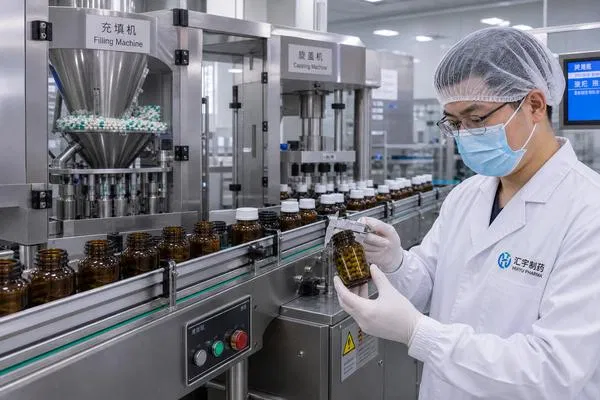
Beyond capacity, ensuring that the glass bottles are engineered for high-speed automated bottling lines is critical to preventing production downtime. Buyers must verify two key technical parameters. First, dimensional tolerance: standard glass manufacturing tolerances should be within ±0.3mm for neck diameters and ±0.5mm for total bottle height. Excessive variance causes automated capping machines to cross-thread caps or crush bottle necks. Second, thermal shock resistance: during automated cleaning or hot-filling, glass bottles must withstand rapid temperature changes. Premium amber glass bottles should carry a thermal shock resistance rating of at least 42°C (108°F) to prevent cracking on the production line.
Sourcing Strategy: Why Matched Sets Protect Your Production
Sourcing glass bottles from one supplier and plastic caps from another is a common practice that frequently leads to compatibility issues. Minor variances in thread pitch, liner thickness, or cap depth can result in micro-leaks that allow moisture to degrade moisture-sensitive capsules or probiotics, and capping line jams that cause automated capping chucks to slip, reducing throughput and increasing defect rates.
By sourcing matched bottle-and-cap sets from a single, vertically integrated manufacturer, B2B buyers eliminate these risks entirely. Matched sets ensure that the glass neck finish — for example, a 38-400 continuous thread — and the child-resistant closure are engineered and tested together to form a flawless, airtight seal. This unified sourcing approach also simplifies compliance documentation, as the manufacturer provides a single set of food-grade certificates covering the entire packaging system, rather than requiring buyers to reconcile separate compliance documents from multiple vendors.
Conclusion: Elevating Supplement Quality with Amber Glass
In the premium wellness and pharmaceutical sectors, packaging is an extension of the product itself. Sourcing amber glass pill and capsule bottles is a strategic investment in product potency, consumer safety, and brand authority. By leveraging the superior UV protection of amber glass and pairing it with certified child-resistant closures, brands can protect their active formulations from light and moisture while complying with strict international safety standards.
The transition from plastic to glass is more than a design upgrade — it is a commitment to purity, efficacy, and environmental responsibility that modern, health-conscious consumers actively seek and are willing to pay a premium for.
Ready to safeguard your supplement formulations with certified amber glass packaging? Contact the technical sourcing team at GlassyPack to request our amber pill bottle catalog, matched CRC samples. Reach us at sales@glassypack.com or visit our Contact Us page.
[1] Photochemical Stability of Vitamins and Active Pharmaceutical Ingredients in Glass vs. Plastic Containers, Journal of Pharmaceutical Sciences, Vol. 113, No. 5, 2024.
[2] The Physics of Light Transmission and Absorption in Amber Glass Packaging, International Journal of Applied Glass Science, 2025.
[3] Light-Induced Degradation of Riboflavin and Ascorbic Acid in Nutritional Supplements, Food Chemistry and Toxicology, Vol. 89, 2024.
[4] Gas and Moisture Permeability Comparison Between PET, HDPE, and Type III Amber Glass, Packaging Technology and Science, Vol. 37, No. 2, 2025.
[5] Regulatory Standards for Child-Resistant and Tamper-Evident Packaging in the Supplement Industry, FDA Compliance and Modernization Journal, 2025.
[6] Optimizing High-Speed Bottling Lines for Glass Containers: Mechanical Stress and Dimensional Tolerance Control, Journal of Manufacturing Processes, Vol. 102, 2024.