
Is your honey or jam packaging protecting your product’s shelf life — or is a poor closure choice quietly putting your brand at risk?
For commercial honey producers, artisan jam makers, and specialty food brands, selecting the perfect glass jar is only half the packaging equation. The lid — or closure system — is the critical engineering component that determines vacuum integrity, prevents leakage, resists corrosion, and ensures food safety compliance. A poor match between a jar’s neck finish and its lid can lead to micro-leaks, spoilage, or costly product recalls.
In the modern food packaging industry, navigating the technical specifications of closures can be daunting. From twist-off (TO) caps and lug closures to continuous thread (CT) lids and traditional two-piece canning systems, each option serves a distinct manufacturing process and consumer expectation. This comprehensive B2B guide decodes the science of honey and jam jar closures, comparing standards, explaining vacuum sealing technology, and providing practical procurement advice for commercial food producers.
The Science of Vacuum Sealing: How Lids Preserve Honey and Jam
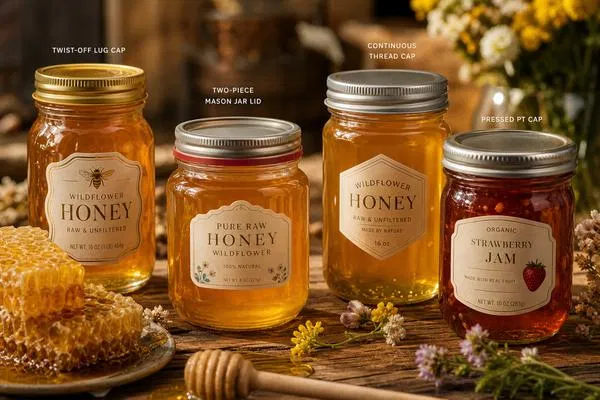
To understand why lid selection is so critical, we must look at the physical and chemical principles of commercial food preservation. Honey and jams are typically packaged using a hot-fill process. During this process, the product is heated to 85°C–95°C (185°F–203°F) to sterilize both the food and the container, poured into the glass jar, and immediately capped.
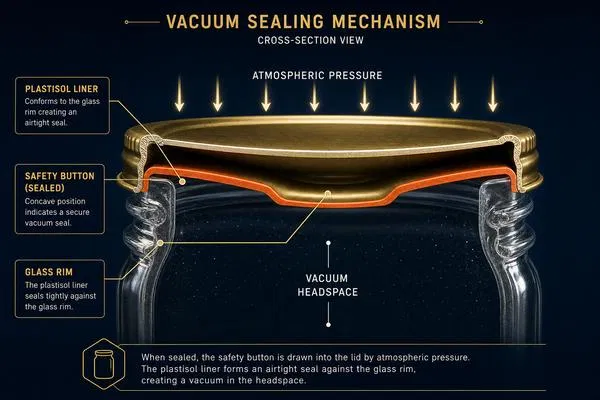
As the hot honey or jam cools inside the sealed jar, the product and the trapped air contract. This contraction creates a partial vacuum — negative pressure — inside the container. The atmospheric pressure outside the jar pushes the flexible center of the lid downward, creating a hermetic, airtight seal. This vacuum seal serves three essential functions: it prevents airborne molds, yeasts, and bacteria from entering the jar; it limits oxygen in the headspace, preventing color degradation and flavor loss; and it protects honey from absorbing ambient moisture. Honey is highly hygroscopic — meaning it naturally draws water vapor from the air. Once its moisture content rises above 18%, fermentation begins, rendering the product unsellable.
“The modern twist-off jar lid was invented by the White Cap Company in Chicago in 1926. Originally designed for baby food, the breakthrough was not the metal lid itself, but the development of a heat-activated plastisol compound lining. This compound could soften during hot-filling, conform to the glass rim’s microscopic imperfections, and solidify upon cooling to hold a high vacuum. This single innovation revolutionized the global commercial canning industry.”
To verify vacuum integrity on a commercial filling line, producers rely on the “button test.” Many modern food lids feature a raised, flexible circular area in the center — the safety button. Under a proper vacuum, this button is pulled concave and rigid. If the seal fails or the jar is opened, the button pops up with a distinct clicking sound, providing a visual and acoustic tamper-evident indicator that consumers have come to trust.
Closure Types Compared: TO, Lug, PT, and CT Standards
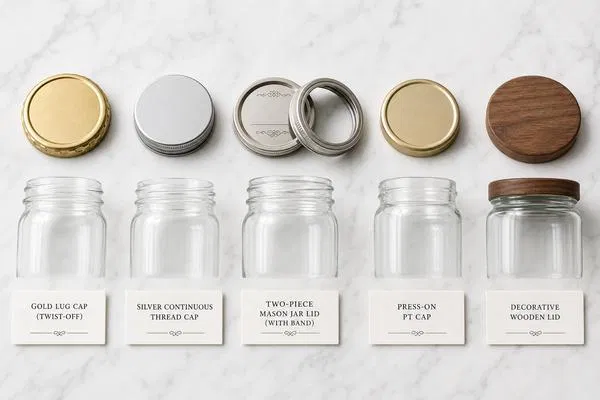
When sourcing lids for honey and jam jars, procurement managers encounter several standard closure designs. Choosing the right one depends on your production volume, automated filling equipment, and brand aesthetic.
Twist-Off (TO) / Lug Caps
Twist-off caps — often called lug caps — are the gold standard for commercial glass food packaging. Unlike continuous thread lids that require multiple full rotations, lug caps utilize a series of small, angled metal tabs (lugs) on the inside rim of the cap. These lugs slide under corresponding ridges on the jar’s neck finish with a simple 1/8 to 1/4 turn. This design is extremely fast and efficient for automated capping machines, provides excellent vacuum retention, and delivers a highly secure seal. For high-volume commercial honey, jam, pickle, and sauce brands, lug caps are the default choice.
Continuous Thread (CT) Lids
Continuous thread lids feature a single, unbroken spiral groove that matches the continuous thread on the jar’s neck. They require multiple full rotations to tighten completely. While familiar to consumers and easy to reclose, CT lids are better suited for dry goods, non-vacuum honey products, cosmetic creams, and home storage jars rather than high-speed hot-fill production lines.
Two-Piece Canning Lids (Mason Jars)
Popularized by Mason and Ball jars, this system consists of a flat metal disc with an integrated plastisol gasket and a separate threaded metal band. The two-piece design delivers a superior vacuum seal for home canning and small-batch artisan production, and the traditional aesthetic is highly trusted by consumers in the farm-to-table and specialty food market. For boutique honey brands and small-batch jam producers, this system offers an authentic, heritage-driven packaging identity.
Press-On Twist-Off (PT) Caps
PT caps are pressed vertically onto the jar neck finish during automated filling. The hot steam used in the capping machine softens the plastisol liner, which molds itself around the glass threads. Once cooled, the cap can be twisted off normally. PT caps deliver maximum vacuum integrity and superior tamper evidence, making them the preferred choice for commercial baby food and high-value nutritional spreads.
Technical Specifications: Neck Finishes and Dimensional Matching
A common and costly sourcing mistake is purchasing glass jars and lids from separate suppliers without verifying dimensional compatibility. In glass manufacturing, neck finishes are strictly standardized. The neck finish is designated by a two-number system — for example, 58-RTO, 63-GPI-400, or 70-G. The first number represents the nominal outer diameter of the glass threads in millimeters; the second number designates the specific thread style or industry standard.
The table below outlines the most common neck finishes and lid standards for honey and jam jars:
| Neck Finish Code | Style Name | Thread Type | Typical Cap Material | Best Product Applications |
|---|---|---|---|---|
| GPI 400 | Continuous Thread (CT) | Single turn, shallow | Tinplate or Plastic | Honey, syrups, dry spices |
| GPI 450 | Deep Continuous Thread | Deep thread, heavy grip | Plastic or Aluminum | High-viscosity liquids, honey |
| RTO / MTO | Regular / Medium Twist-Off | Lug (multi-tab) | Tinplate (with plastisol) | Hot-fill jam, honey, sauces |
| 70-G | Mason Jar Finish | Heavy thread | Two-piece tinplate | Artisan jams, preserves, pickles |
To ensure a perfect hermetic seal, B2B buyers must also verify that the lid’s inner plastisol liner is rated for the filling temperature of their product. Standard plastisol liners handle hot-fill temperatures up to 95°C (203°F). If your production line uses retort sterilization — heating the sealed jar above 100°C under pressure — you must specify a high-temperature “retort-grade” plastisol liner to prevent compound degradation and seal failure.
Coating Standards and Corrosion Prevention for Food-Safe Lids
Because jams, jellies, and pickles contain high levels of organic acids — citric acid, malic acid, and acetic acid — the metal lids must be chemically protected from corrosion. Standard jar lids are manufactured from tinplate (tin-coated steel) or aluminum. Without protective coatings, the acids in the food can react with the metal, causing rust, off-flavors, and black spots on the inside of the lid.
Commercial food-safe lids feature a multi-layer coating system. The steel base provides structural strength; a tin coating protects the steel from moisture; a passivation layer enhances lacquer adhesion; and finally, an internal lacquer acts as a protective polymer barrier between the metal and the food. Historically, epoxy-phenolic resins containing BPA (Bisphenol A) were the industry standard for this inner lacquer. However, strict global food safety regulations — including EU Regulation 2022/1616 and ongoing FDA modernization — have accelerated the transition to BPA-Non-Intent (BPA-NI) coatings. These modern polyester-based lacquers provide equivalent acid resistance without the health concerns associated with BPA migration into food.
When sourcing metal closures, commercial food producers must request compliance certificates confirming that the internal coatings are food-grade, acid-resistant, and BPA-NI compliant under both FDA and EU 1935/2004 standards.

How to Optimize Your Sourcing and Capping Workflow
To minimize packaging defects and maximize production efficiency, food producers should implement these best practices when sourcing glass jars and closures.
Source Matched Sets from a Single Supplier
Sourcing glass jars from one factory and metal lids from another introduces dimensional tolerance risks. Glass has a natural thermal expansion tolerance, and metal caps have stamping tolerances. If these tolerances clash, the seal can fail. Sourcing matched jar-and-lid sets from a single, vertically integrated manufacturer ensures that the glass neck finish and cap thread are engineered to fit together precisely, eliminating leakage risks and simplifying your quality control documentation.
Calibrate Your Steam Injection System
If your filling line uses automated lug capping machines, ensure the steam injection system is properly calibrated. Steam serves two critical functions: it displaces oxygen in the jar’s headspace — creating a higher vacuum upon cooling — and it softens the plastisol liner just enough to allow the glass lugs to seat deeply without tearing the compound. Under-steaming leads to weak vacuums; over-steaming can damage the liner and cause premature lid corrosion.
Implement Post-Fill Acoustic Quality Control
After cooling, implement a mandatory 100% inspection protocol using an acoustic tap-tester or vacuum button-sensor. These automated systems detect and eject any jars with failed seals before cartoning and palletizing, preventing defective product from reaching retail shelves and protecting your brand’s reputation.
Conclusion: Securing Your Brand from Top to Bottom
In the competitive food industry, your packaging is your brand’s first line of defense. A beautifully designed honey or jam jar will fail to build consumer trust if the lid leaks, rusts, or fails to hold its vacuum seal. By understanding the material science, dimensional standards, and chemical coatings of glass jar closures, procurement managers can secure their product’s integrity from the moment it leaves the filling line to the moment a consumer opens it at home.
The right closure is not simply a cap — it is a precision-engineered food safety component. Selecting it with the same care you apply to your glass jar, your formula, and your label is what separates professional food brands from amateur operations.
Looking for matched glass honey jars and food-safe lids with full FDA and EU compliance documentation? Contact the sourcing team at GlassyPack to request our honey and jam jar catalog, matched lid samples, and compliance certificates. Reach us at sales@glassypack.com or visit our Contact Us page.
[1] Food Packaging Closures: Technology, Materials, and Food Safety Standards, Journal of Food Science and Technology, Vol. 61, No. 4, 2024.
[2] Guidelines for Hot-Fill and Thermal Processing of Glass-Packaged Acid Foods, International Journal of Food Engineering, 2025.
[3] The Role of Hermetic Sealing in Preventing Fermentation and Moisture Absorption in Commercial Honey, Bee Product Quality Journal, Vol. 48, 2025.
[4] Standardization of Glass Container Neck Finishes and Closure Compatibility, Glass Packaging Institute (GPI) Technical Bulletin, 2025.
[5] Plastisol Compound Formulations for High-Temperature Retort and Pasteurization Processing, Polymer Testing in Food Packaging, 2024.
[6] Transitioning to BPA-Non-Intent (BPA-NI) Internal Lacquers for Metal Food Closures: Regulatory Compliance and Chemical Stability, Food Additives & Contaminants: Part A, Vol. 43, 2026.