
Is your glass packaging supply chain suffering from hidden “shrinkage” due to transit damage? In 2026, with trans-Pacific shipping rates remaining volatile and supply chains stretching across multiple intermodal nodes, brands can no longer afford to accept a 3–5% breakage rate as a “cost of doing business.” Every shattered jar represents lost revenue, wasted freight spend, and potential damage to surrounding inventory. This article breaks down the physics of glass breakage during international transit and explains how strategic palletization, advanced carton design, and proper load securing can reduce your damage rate to near zero.
- Glass-on-glass contact during transit is the single leading cause of breakage; full-height corrugated dividers eliminate this risk entirely.
- Cartons that overhang the pallet edge by even a few centimeters lose up to 30% of their compressive strength, making them highly vulnerable to forklift damage.
- Thermal shock from container temperature swings can turn microscopic manufacturing defects into full cracks before a jar reaches the filling line.
- A properly engineered export packaging system — carton grade, divider design, pallet build, and load securing — can reduce transit breakage to near zero.
Understanding the Physics of Transit Damage
Glass Has Three Enemies in Transit: Impact, Vibration, and Thermal Shock
Glass is an inherently strong material with high compressive strength, meaning it can support significant top-down weight. However, it is highly susceptible to tensile stress caused by lateral impacts or sustained harmonic vibrations. During a typical ocean freight journey from China to North America or Europe, a shipping container will endure thousands of micro-impacts from crane handling, truck suspension vibrations, and the rolling pitch of the cargo ship [1]. If glass jars are allowed to clink against each other — glass-on-glass contact — these micro-impacts quickly compound into micro-fractures, leading to catastrophic failure well before the destination.
Thermal Shock Is a Hidden Risk That Most Buyers Overlook
While mechanical stress is the primary culprit, thermal shock also plays a significant role in transit breakage. Shipping containers crossing the equator or sitting in sun-baked port terminals can experience temperature swings of 30°C or more within a single day. If a glass jar has microscopic manufacturing defects — often found in low-quality, cheaply sourced glass — these temperature swings cause the glass to expand and contract unevenly, turning a minor flaw into a major crack before the jar even reaches the filling line. Sourcing high-quality, properly annealed flint glass, such as our premium Mason jars, is the first line of defense against both mechanical and thermal stress.
The True Cost of Transit Damage Goes Far Beyond the Broken Jar
Procurement teams often focus solely on the unit cost of the glass jar, treating the corrugated carton and palletizing materials as an afterthought. This is a critical miscalculation. A single broken jar in a tightly packed carton can contaminate and damage the surrounding jars with glass shards, multiplying the loss. Upgrading from a single-wall carton to a double-wall carton with custom dividers might add a few cents to the packaging cost, but it can save thousands of dollars in lost inventory, disposal fees, and customer chargebacks at the destination warehouse. As we explored in our analysis of packaging material total cost, the true cost of glass includes its landed, intact yield — not just the ex-works price.
A Glimpse into Shipping History: The standardization of the intermodal shipping container in 1956 by Malcom McLean revolutionized global trade, but it also introduced new challenges for fragile goods [2]. Before containerization, glass was routinely packed in wooden crates stuffed with straw or sawdust — a method that, while low-tech, was remarkably effective at absorbing vibration. Today, advanced corrugated engineering and precision stretch-wrapping have replaced straw, enabling high-density, low-breakage global transport at scale.
Strategic Carton Design and Palletization
Full-Height Corrugated Dividers Are Non-Negotiable for Glass Export
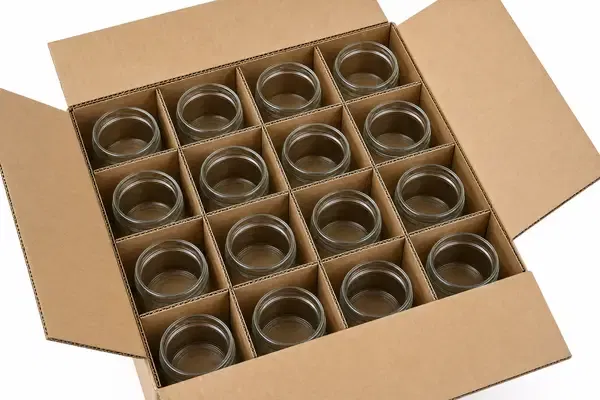
The golden rule of shipping glass is that no two jars should ever touch. Standard export cartons must utilize full-height corrugated dividers (partitions) that create individual cells for each jar. For heavier items like large pickle jars or wide-mouth mason jars, these dividers should be made of double-wall corrugated board. The dividers not only prevent lateral impact but also significantly increase the vertical stacking strength of the carton by transferring the compressive load away from the glass and onto the cardboard structure — a critical benefit when pallets are stacked two or three high in a container.
Pallet Build Quality Determines Whether Your Carton Engineering Actually Works
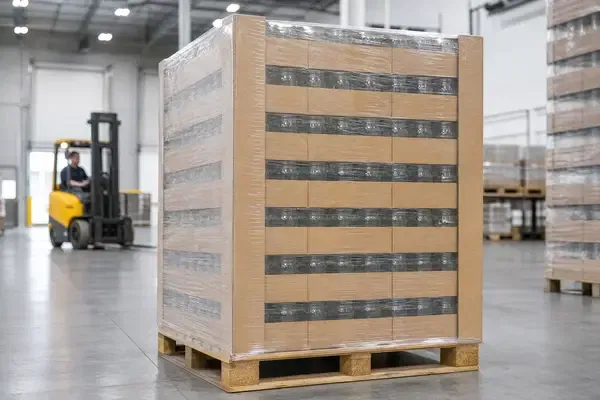
A well-designed carton is useless if the pallet is built incorrectly. Cartons must be stacked in an interlocking (brick) pattern to maximize lateral stability. The footprint of the cartons should perfectly match the dimensions of the pallet — typically 40″ × 48″ for North America or 800mm × 1200mm for Europe — with zero overhang. Cartons that hang over the edge of the pallet lose up to 30% of their compressive strength and are highly vulnerable to forklift tine damage during cross-docking operations [3]. This single error accounts for a disproportionate share of damage claims in international glass shipments.
Stretch Wrapping and Corner Boards Lock the Entire Load Into One Rigid Unit
Once the pallet is stacked, it must be secured as a single, rigid unit. This requires high-tension stretch wrapping starting from the wooden base of the pallet and spiraling upward with at least 50% overlap on each pass. For heavy loads of glass packaging, rigid fiberboard corner boards (edge protectors) must be applied to all four vertical corners before wrapping. These boards distribute the tension of the stretch wrap evenly across the carton faces and protect the corners from crushing under strapping bands during container loading. The final result should be a pallet that cannot flex, shift, or compress under normal handling forces.
| Packaging Component | Standard Practice (High Risk) | GlassyPack Export Standard (Low Risk) |
|---|---|---|
| Carton Material | Single-wall corrugated (3-ply) | Double-wall corrugated (5-ply) for jars over 500g |
| Internal Dividers | Half-height or no dividers | Full-height, snug-fit corrugated partitions |
| Pallet Alignment | Carton overhang accepted | Zero overhang, flush alignment to pallet edge |
| Load Securing | Basic stretch wrap only | Heavy-duty stretch wrap + rigid fiberboard corner boards |
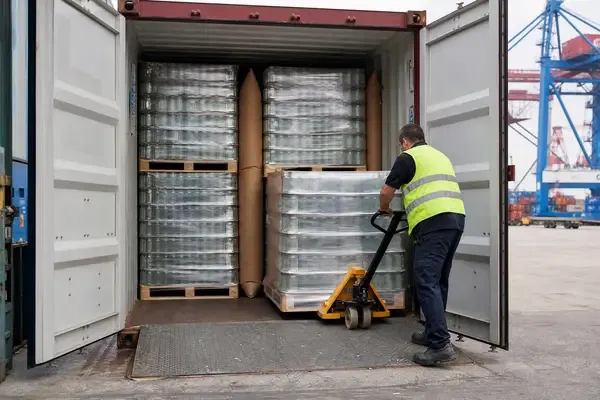
| Void Filling | Empty space left in container | Dunnage airbags in all void spaces |
The GlassyPack Commitment to Safe Arrival
Breakage Prevention Starts at the Furnace, Not the Packing Line
Preventing transit breakage starts long before the jars are packed. At GlassyPack, every batch of glass undergoes rigorous controlled annealing to relieve internal stresses introduced during the forming process. This is followed by automated optical inspection to detect micro-fractures, thin walls, or uneven glass distribution. We only ship structurally sound glass, ensuring that your honey and jam jars are inherently capable of surviving the rigors of intermodal transport [4]. A jar that passes our QC line will not develop a spontaneous fracture in transit.
Custom Export Packaging Is Engineered to Your Specific SKU
We do not apply a one-size-fits-all approach to export packaging. Our logistics team designs custom carton dimensions and divider configurations based on the specific weight, shape, and fragility index of each SKU. Whether you are shipping small 100ml spice jars or heavy 2-liter bulk containers, we calculate the exact compressive load requirements for your stacking height and route, then specify the correct carton grade accordingly. This engineering step is included as a standard part of every GlassyPack order — not an optional add-on.
Optimized Container Loading Eliminates the Final Source of Damage
The last mile of protection is how the pallets are loaded into the shipping container. We use a stowage plan that distributes weight evenly across the container floor and minimizes void space. Dunnage airbags are placed in any remaining gaps between pallets to prevent lateral movement during the ocean voyage. The result is a container load that behaves as a single, immovable block — resistant to the rolling, pitching, and yawing forces of a cargo ship crossing the Pacific or Atlantic.

Conclusion
Accepting high breakage rates as an inevitable part of importing glass is an outdated and costly mindset. By understanding the physics of transit damage and insisting on engineered packaging standards — from carton grade and divider design to pallet build and container loading — brands can virtually eliminate transit losses. The right manufacturing partner does not just make a good glass jar; they ensure that jar arrives at your filling line in perfect condition, every shipment.
If you are experiencing unacceptable breakage rates with your current supplier, or if you are sourcing glass packaging for the first time and want to get the logistics right from the start, we would be glad to walk you through GlassyPack’s export packaging standards. Contact us at sales@glassypack.com or visit our Contact Us page to request a sample kit and packaging specification sheet.
FAQ
What is the most common cause of glass jar breakage during shipping?
Glass-on-glass contact is the single leading cause of transit breakage. When jars are packed without full-height corrugated dividers, vibration during ocean freight causes jars to clink against each other, generating micro-fractures that eventually lead to catastrophic failure. Full-height partitions in every carton cell eliminate this risk entirely.
What carton specification should I request for glass jar exports?
For jars weighing over 500g when filled, request double-wall corrugated cartons (5-ply, minimum ECT-48) with full-height, snug-fit dividers. For lighter jars under 500g, single-wall (3-ply, ECT-32) with dividers is typically sufficient. Always specify the carton grade in your purchase order — do not leave it to supplier discretion.
Can I reduce breakage by switching to thicker glass?
Thicker glass improves resistance to point impacts but does not significantly reduce breakage caused by vibration-induced glass-on-glass contact. The most cost-effective solution is always improved carton design and dividers, not heavier glass. Heavier glass also increases freight costs and carbon footprint without proportional breakage reduction.
What is a dunnage airbag and why is it important for glass shipments?
A dunnage airbag is an inflatable cushion placed in the void spaces between pallets inside a shipping container. It prevents pallets from shifting laterally during the ocean voyage, which is the primary cause of pallet-level damage. For glass shipments, void filling with airbags is considered best practice on any route longer than 10 days at sea.
How does thermal shock cause glass breakage in transit?
Thermal shock occurs when glass is exposed to rapid temperature changes, causing uneven expansion and contraction. Containers sitting in tropical ports or crossing the equator can experience 30°C+ temperature swings within hours. If the glass contains microscopic manufacturing defects from poor annealing, these thermal stresses can propagate the defect into a full crack. Sourcing properly annealed glass from a quality-controlled manufacturer is the primary defense.
What is the typical acceptable breakage rate for glass jar imports, and how can I improve it?
Industry-accepted breakage rates for glass packaging typically range from 0.5% to 2% for well-packaged shipments, and can reach 5% or higher with poor packaging. If your current rate exceeds 1%, the issue is almost always packaging design rather than glass quality. Requesting a packaging audit from your supplier — covering carton grade, divider design, pallet build, and container loading plan — is the fastest way to identify and fix the root cause.
References
[1] Supply Chain Dive. (n.d.). Supply Chain News and Analysis. https://www.supplychaindive.com/
[2] Wikipedia. (n.d.). Containerization. https://en.wikipedia.org/wiki/Containerization
[3] International Safe Transit Association (ISTA). (n.d.). Packaging Performance Testing Standards. https://www.ista.org/
[4] Wikipedia. (n.d.). Intermodal freight transport. https://en.wikipedia.org/wiki/Intermodal_freight_transport