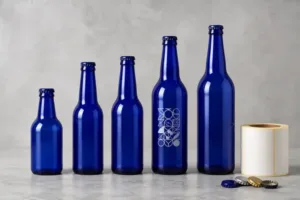
When a buyer opens a bottle of premium vodka or single-malt whisky, the first thing they notice is not the liquid — it is the glass. Does it sparkle with near-crystal clarity, or does it carry a faint greenish tint that quietly undermines the brand’s premium positioning? The difference often comes down to a single material decision made long before the product reaches the shelf: the choice between super flint and high flint glass. This guide explains what separates these two grades, how each performs across the key dimensions that matter to spirits brands, and how to make the right call for your packaging project.
- Super flint glass contains a higher silica content and stricter raw material specifications, producing near-crystal clarity with virtually no color cast.
- High flint glass is the industry standard for most commercial spirits and offers excellent clarity at a lower cost per unit.
- The visual difference between the two grades is most apparent in thick-walled or heavyweight bottles, where glass depth amplifies any residual tint.
- For vodka, gin, and premium tequila — where visual purity is part of the product story — super flint is the preferred choice among top-tier brands.
What Is Glass Flint Grade, and Why Does It Matter?
Flint Grade Defines the Optical Purity of Glass
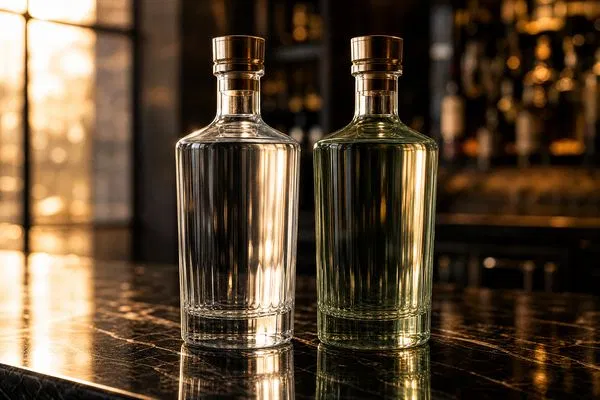
Flint grade is a measure of how optically pure a glass batch is — specifically, how free it is from iron and other trace minerals that introduce color. All clear glass contains some level of iron oxide from raw silica sand; the question is how much, and how it is managed. Standard clear glass (sometimes called “extra white” or “flint”) typically contains iron oxide levels around 0.02–0.05%. High flint glass reduces this to below 0.02% through the use of higher-purity silica sand and more rigorous raw material selection. Super flint glass goes further still, pushing iron content below 0.01% and often adding decolorizing agents such as selenium or cerium oxide to neutralize any remaining color cast.[1]
Why does iron content matter? Iron oxide in glass produces a green or blue-green tint that becomes increasingly visible as glass thickness increases. In a thin-walled 330ml beer bottle, the tint is barely perceptible. In a heavyweight 750ml spirit bottle with a thick punt and substantial walls — designed to convey luxury and substance — the same iron level can produce a distinctly green hue that contradicts the brand’s premium positioning. For spirits brands where the bottle is a core part of the product experience, this is not a cosmetic detail; it is a brand integrity issue.
Super Flint vs. High Flint: A Technical Comparison
The Differences Become Critical at High Bottle Weights
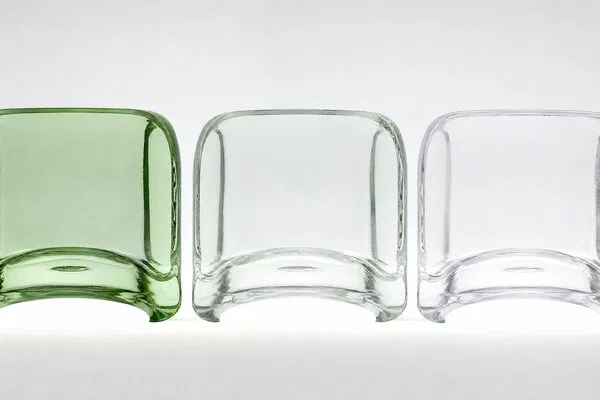
High flint glass delivers excellent clarity for the vast majority of spirit bottle applications. A standard 750ml high-flint bottle with walls of moderate thickness will appear clear and bright on a retail shelf. The limitations of high flint only become apparent under specific conditions: very thick walls, deep punts, or bottles designed to be viewed from angles where light passes through a significant depth of glass. In these scenarios, the residual iron content in high flint glass creates a faint but visible green cast — particularly noticeable when the bottle is backlit or displayed under warm retail lighting.
Super flint glass eliminates this issue by reducing iron content to near-zero levels and actively neutralizing any remaining tint through decolorizing chemistry. The result is a glass that behaves more like optical crystal than standard packaging glass — with a brilliance and sparkle that amplifies the visual impact of any surface decoration, from acid frosting to ceramic labeling. For brands that have invested in premium bottle design, the incremental cost of super flint glass is often the most cost-effective way to ensure the finished product matches the design intent.[2]
A Glimpse into Glass History: The pursuit of colorless glass dates back to ancient Rome, where glassmakers discovered that adding manganese dioxide to their batches could neutralize the green tint caused by iron impurities — a technique they called “glassmaker’s soap.” For nearly two millennia, manganese remained the primary decolorizing agent in clear glass production. It was only in the 20th century that selenium and cerium oxide replaced it as the preferred decolorizers, offering more precise color control and better UV stability in modern super flint formulations.
| Property | High Flint | Super Flint |
|---|---|---|
| Iron Oxide Content | < 0.02% | < 0.01% (with decolorizers) |
| Visual Clarity | Excellent — faint tint in thick walls | Near-crystal — no perceptible tint |
| Light Transmission | ~88–90% | ~92–94% |
| Typical Unit Price Premium | Baseline | +8–15% over high flint |
| Best For | Whisky, rum, brandy, mid-tier spirits | Vodka, gin, premium tequila, luxury spirits |
| Decoration Compatibility | All standard techniques | All techniques; frosting and ceramic labels show more brilliance |
| MOQ Availability | 10,000–20,000 pcs (standard) | 10,000–20,000 pcs (some factories require higher minimums) |
Which Grade Is Right for Your Spirit Brand?
Match Glass Grade to Bottle Weight and Brand Positioning
The decision between super flint and high flint is not simply about quality — it is about matching the material to the visual requirements of the specific bottle design and the price tier of the product. For a standard 750ml whisky bottle with walls of moderate thickness, high flint glass will perform beautifully and deliver excellent shelf presence at a lower cost. The green cast, if present at all, will be minimal and unlikely to register with consumers. For the same whisky brand’s ultra-premium expression — packaged in a heavyweight, thick-walled bottle with a deep punt designed to be displayed on a back bar — super flint becomes the logical choice. The additional 8–15% material cost is negligible relative to the overall packaging investment, and the visual payoff is significant.
For vodka and gin brands specifically, super flint is close to a category standard at the premium tier. These spirits are colorless by definition, and the bottle’s clarity is a direct proxy for the product’s purity in the consumer’s mind. Brands like Grey Goose, Belvedere, and Hendrick’s have set a visual benchmark in their respective categories that makes super flint glass effectively mandatory for any new entrant positioning itself at the same price point. A bottle that looks slightly green next to a competitor’s crystal-clear offering will face a perception gap that no amount of label design can fully overcome. For brands sourcing custom liquor bottles, specifying super flint at the outset is far more cost-effective than discovering the issue after production.
For brands that are cost-sensitive or launching at a mid-tier price point, high flint glass remains an excellent and widely used choice. The majority of the world’s best-selling whisky, rum, and brandy brands use high flint glass without any compromise to their brand image. The key is to design the bottle with the glass grade in mind — avoiding extremely thick walls or deep punts that would amplify any residual tint, and choosing surface decorations that complement rather than expose the glass’s natural characteristics. For a detailed breakdown of how bottle weight and material grade affect your total sourcing cost, see our guide: How Much Do Custom Liquor Bottles Cost? A Pricing & MOQ Guide.[3]
Conclusion: A Material Decision That Shapes Brand Perception
The choice between super flint and high flint glass is one of the most consequential material decisions in spirit bottle design — and one of the least discussed. Both grades are technically excellent; the difference lies in the visual outcome, and that outcome is most visible precisely where it matters most: in premium, heavyweight bottles designed to command attention on a shelf or back bar. Super flint is the right choice when optical purity is a brand requirement; high flint is the right choice when cost efficiency matters more than marginal clarity gains.
If you are developing a custom spirit bottle and are unsure which glass grade is appropriate for your design, we are glad to help. Share your bottle specifications — including target weight, wall thickness, and decoration plan — and our team will provide a clear recommendation along with a transparent cost comparison. Reach us at sales@glassypack.com or visit our Contact Us page.
FAQ
What is the difference between super flint and high flint glass?
Super flint glass has a lower iron oxide content (below 0.01%) and uses decolorizing agents to achieve near-crystal clarity with no perceptible color cast. High flint glass has slightly higher iron content (below 0.02%) and delivers excellent clarity for most applications, with a faint green tint only visible in very thick-walled bottles.
Is super flint glass stronger than high flint glass?
No. Glass strength is determined by wall thickness, annealing quality, and tempering — not by flint grade. Super flint and high flint glass of the same wall thickness have essentially identical mechanical strength. The flint grade affects optical clarity only, not structural performance.
Which spirit categories most commonly use super flint glass?
Vodka, gin, and premium tequila are the categories where super flint is most commonly specified, as these spirits are colorless and the bottle’s clarity directly reflects the product’s perceived purity. High-end whisky and rum brands also use super flint for their ultra-premium expressions, particularly in heavyweight collector bottles.
How much more does super flint glass cost compared to high flint?
Super flint typically adds 8–15% to the per-unit glass cost compared to high flint at the same bottle weight and design. For a 750ml bottle priced at $0.60 per unit in high flint, the super flint equivalent would cost approximately $0.65–$0.69 per unit. The premium narrows at higher order volumes.
Can I switch from high flint to super flint mid-production without changing the mold?
Yes. Glass grade is a raw material specification, not a mold specification. If you have an existing mold and want to upgrade to super flint for a new production run, you simply specify the grade change with your manufacturer. No new mold is required, and the bottle shape remains identical.
Does super flint glass affect the taste or safety of spirits?
No. Both super flint and high flint glass are chemically inert and food-safe. The decolorizing agents used in super flint (selenium, cerium oxide) are present in trace quantities and are fully encapsulated within the glass matrix — they do not leach into the contents under normal storage conditions.
Is super flint glass available from Chinese manufacturers?
Yes. Several major Chinese glass manufacturers produce super flint glass to international specifications, and it is widely available for custom spirit bottle projects. Lead times and MOQs are generally the same as for high flint glass, though some factories may require a slightly higher minimum for super flint batches due to the more stringent raw material sourcing requirements.
References
[1] Glass Packaging Institute. Facts About Glass. https://www.gpi.org/facts-about-glass
[2] Owens-Illinois (O-I). Sustainability. https://www.o-i.com/sustainability/
[3] Statista. Spirits Industry — Topic Overview. https://www.statista.com/topics/1569/spirits-industry/