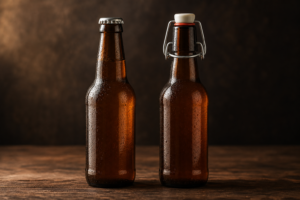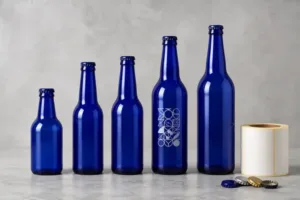
Quick Answer: The ideal glass bottle for cold brew coffee is a 250ml or 355ml amber glass bottle with a 38/400 screw cap (CT finish) to protect against UV degradation. For kombucha, use a 330ml or 473ml glass bottle with a swing-top closure or 26mm crown cap, rated for a minimum burst pressure of 6 bar to safely handle secondary fermentation carbonation.
- Amber glass extends the shelf life of cold brew coffee by 30–40% compared to clear glass by blocking UV rays that degrade flavor compounds.
- Kombucha fermentation can generate 45–60 PSI of internal pressure; standard juice bottles are not safe for live-culture kombucha.
- Stock glass bottles offer low minimum order quantities (MOQ) of 500–2,000 units, making them the safest choice for market testing before investing in custom molds.
- According to 2022 industry surveys, 73% of consumers prefer food and beverage products in glass packaging due to its sustainability and premium feel.
Is your beverage packaging sabotaging your product’s flavor before it even reaches the shelf? The functional beverage market is growing at double digits—but most emerging cold brew and kombucha brands are sourcing their glass bottles wrong. Buying the wrong neck finish or underestimating carbonation pressure can lead to leaking caps, flat drinks, or worse, exploding bottles. This article breaks down the exact specifications, sizes, and closures you need to successfully source cold brew coffee and kombucha glass bottles.
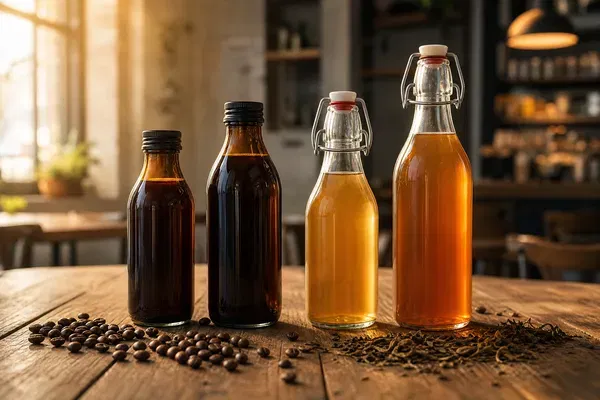
Why do cold brew and kombucha brands choose glass over plastic or aluminum cans?
Glass is chemically inert, making it the only packaging material that preserves the delicate flavor profiles of cold brew and live-culture kombucha without interference. Unlike plastic (PET) or aluminum cans with plastic liners, glass does not leach chemicals or absorb odors. For cold brew coffee, which relies on a slow extraction process to highlight subtle tasting notes, flavor neutrality is critical. For kombucha, the acidic nature of the fermented tea (often with a pH below 3.0) can interact with plastic over time, altering the taste and potentially degrading the packaging.
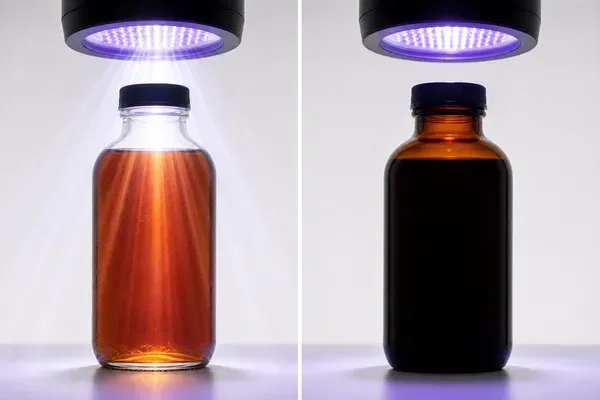
Amber glass provides essential UV protection, extending the shelf life of cold brew coffee by 30–40% compared to clear glass. Cold brew coffee degrades rapidly when exposed to light, leading to oxidation and a stale, cardboard-like flavor. While clear glass is popular for showcasing the vibrant colors of fruit-flavored kombucha, amber glass bottles remain the industry standard for coffee because they block over 99% of harmful ultraviolet rays.
Consumer perception heavily favors glass for premium and sustainable positioning. Studies show that consumers associate glass with higher quality and are willing to pay a premium for it. According to a 2022 poll by the Glass Packaging Institute, 73% of respondents stated they wished more companies offered their food and beverage products in glass packaging [1]. Furthermore, glass’s infinite recyclability aligns perfectly with the health-conscious and eco-minded demographic that drives the functional beverage market.
What bottle size and neck finish should I choose for cold brew coffee or kombucha?
The standard retail sizes for cold brew coffee are 250ml (single-serve) and 355ml (US standard), while kombucha typically utilizes 330ml (EU standard) and 473ml (US pint) bottles. Choosing a standard size is crucial for retail shelf placement and consumer expectations. For concentrated cold brew intended for home dilution, larger 500ml and 1000ml beverage bottles are preferred. Selecting a widely accepted capacity ensures compatibility with standard shipping cartons and retail display racks.
Cold brew coffee typically uses a 38mm screw cap (CT finish), whereas kombucha requires a pressure-rated closure like a swing-top or a 26mm crown cap. The neck finish dictates the type of closure you can use. A 38/400 continuous thread (CT) finish is ideal for cold brew because it provides a reliable seal for non-carbonated liquids and is easy for consumers to reseal. However, this closure is generally not suitable for highly carbonated kombucha.
Kombucha bottles must be rated for high internal pressure, as secondary fermentation can generate 45 to 60 PSI (3.1 to 4.1 bar). This is a critical safety specification. Using standard juice bottles for kombucha can result in catastrophic failure. A proper kombucha bottle should have a minimum burst pressure rating of 6 bar. The classic swing-top closure (Grolsch-style) or a crimped crown cap are designed to safely contain this pressure while maintaining the carbonation that consumers expect.
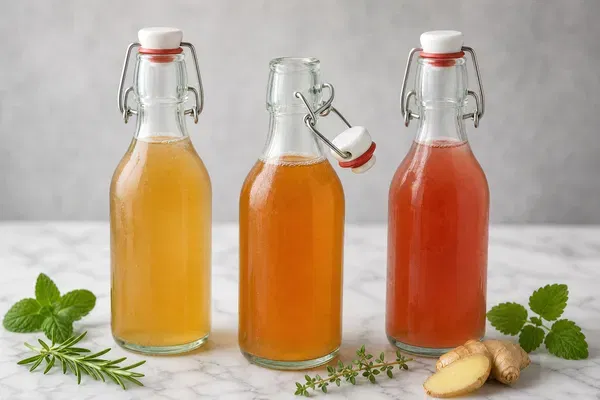
A Glimpse into Glass History: The classic swing-top closure, also known as a flip-top, was invented in 1875 by Nicolai Fritzner in Germany. It was originally designed to solve the problem of sealing highly carbonated beer bottles before the invention of the modern crown cork. Today, it remains the signature closure for artisan kombucha brands worldwide, signaling traditional fermentation and premium quality. [2]
What is the minimum order quantity for glass bottles, and how do I start small without overpaying?
Stock glass bottles offer the lowest barrier to entry, with Minimum Order Quantities (MOQs) typically ranging from 500 to 2,000 pieces. For emerging brands testing a new cold brew or kombucha recipe in local markets, stock bottles are the smartest financial choice. They carry no tooling fees and have short lead times of 2 to 3 weeks. You can achieve brand differentiation on stock bottles through custom labeling, silk-screen printing, or unique cap colors without the heavy upfront investment of a custom mold.
Custom mold bottles require an MOQ of 20,000 to 200,000 pieces and involve tooling fees of $1,500 to $6,000, making them suitable only for established brands scaling production. While a custom shape provides ultimate brand recognition, the 45 to 60-day lead time and higher volume commitment tie up significant cash flow. Brands should transition to custom molds only after achieving consistent sales volume and securing regional distribution.
| Sourcing Strategy | Typical MOQ | Tooling Cost | Lead Time | Best For |
|---|---|---|---|---|
| Standard Stock Bottles | 500 – 2,000 pcs | $0 | 2 – 3 weeks | Startups, market testing, local distribution |
| Stock Bottle + Custom Print | 2,000 – 5,000 pcs | $100 – $300 (Print setup) | 3 – 4 weeks | Growing brands seeking differentiation |
| Full Custom Mold | 20,000 – 200,000+ pcs | $1,500 – $6,000 | 45 – 60 days | Established brands, national distribution |
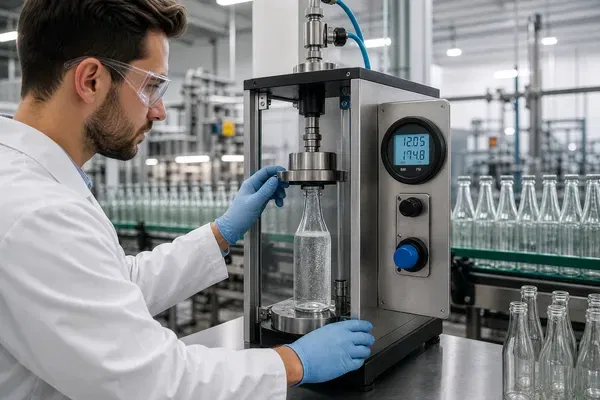
Supplier verification is critical: always request bottle parameter, samples to test in production line, and food contact compliance documentation before placing a bulk order. In early 2025, we worked with a beverage startup from North America looking to order 10,000 to 20,000 units for their new hard kombucha line. They had previously sourced standard juice bottles from a domestic distributor, which resulted in a 4% breakage rate on retail shelves due to carbonation buildup. We transitioned them to a 330ml heavy-wall glass bottle specifically engineered for carbonated beverages, complete with burst pressure test reports. By matching the correct bottle specification to their fermentation process, their breakage rate dropped to zero.
Conclusion: Securing the Right Packaging for Your Beverage Brand
The global cold brew coffee and kombucha markets are projected to reach $8.36 billion and $7.01 billion respectively by 2031 [3] [4]. However, this market rewards brands that get their packaging right from day one. Whether you are launching with 500 units or scaling to 50,000, the right glass bottle specification—accounting for UV protection, carbonation pressure, and neck finish—can be the difference between a product that sells out and one that leaks on the shelf.
If you are an emerging beverage brand looking to source reliable, compliant glass packaging without excessive MOQs, we would be glad to share how GlassyPack can support your growth. Contact us today at sales@glassypack.com or visit our Contact Us page to request a free specification consultation and sample bottles.
FAQ
Amber glass blocks over 99% of harmful ultraviolet (UV) rays. UV exposure degrades the delicate flavor compounds and oils in cold brew coffee, causing oxidation and a stale taste. Using amber glass extends the shelf life by 30–40% compared to clear glass.
No, standard juice bottles are not safe for live-culture kombucha. Kombucha undergoes secondary fermentation in the bottle, which can generate internal pressures of 45 to 60 PSI. You must use pressure-rated bottles (minimum 6 bar burst pressure) to prevent the glass from exploding.
The best closures for kombucha are swing-top (flip-top) caps or 26mm crimped crown caps. These closures are specifically designed to hold high internal carbonation pressure securely without leaking, unlike standard continuous thread (CT) screw caps.
The most common retail sizes for ready-to-drink cold brew coffee are 250ml (single-serve) and 355ml (US standard 12oz). For cold brew concentrates intended for dilution at home, 500ml and 1000ml bottles are standard.
For a completely custom glass bottle mold, the MOQ typically ranges from 20,000 to 200,000 pieces, plus a tooling fee of $1,500 to $6,000. For startups, using standard stock bottles with custom printing is a more cost-effective option, often requiring an MOQ of just 500 to 2,000 pieces.
References
[1] Glass Packaging Institute. (2022). GPI survey reveals US consumers want more glass packaging. https://www.gpi.org/gpi-news/gpi-survey-reveals-us-consumers-want-more-glass-packaging
[2] Flip-top Bottles. A brief history of flip-top bottles. https://fliptopbottles.wordpress.com/a-brief-history-of-flip-top-bottles/
[3] Mordor Intelligence. (2026, May). Cold Brew Coffee Market Size & Share Analysis. https://www.mordorintelligence.com/industry-reports/cold-brew-coffee-market
[4] Mordor Intelligence. (2026, January). Kombucha Market Size & Share Analysis. https://www.mordorintelligence.com/industry-reports/kombucha-market