
Are you losing thousands of dollars to honey fermentation during bulk export? In the global honey trade, fermentation is a silent profit killer that ruins perfectly good batches before they even reach the retail shelf. When moisture levels creep up and wild yeasts activate, the resulting spoilage can damage your brand reputation and trigger massive returns. This article breaks down the science of honey fermentation and explains how combining glass jars with metal lug caps creates an impenetrable barrier to protect your bulk shipments.
- The Codex Alimentarius international standard mandates that honey moisture content must remain below 20% to prevent fermentation.
- Honey is highly hygroscopic; if packaged in porous materials, it will absorb ambient humidity and trigger osmophilic yeast growth.
- Glass is completely inert and provides an absolute moisture vapor transmission rate (MVTR) of zero, unlike plastic alternatives.
- Metal lug caps with plastisol liners create a hermetic vacuum seal that locks out moisture and oxygen during long-term storage.
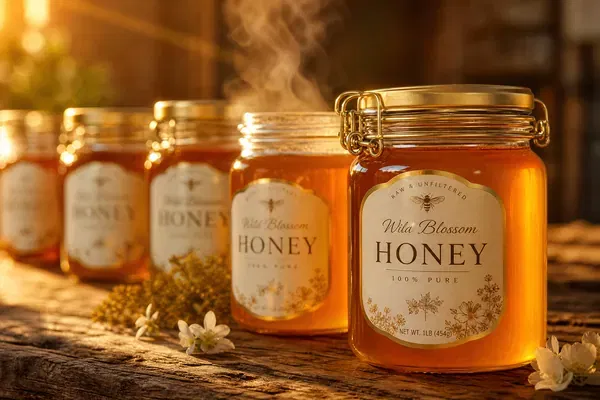
The Science of Honey Fermentation: Moisture and Yeast
Fermentation occurs when honey’s moisture content exceeds safe thresholds, allowing naturally occurring osmophilic yeasts to multiply. Honey is naturally hygroscopic, meaning it actively attracts and absorbs moisture from the surrounding air. According to the Codex Alimentarius international standard, honey must have a moisture content of no more than 20% (with the exception of heather honey) to be considered safe from fermentation [1]. When the water content rises above this critical level, the sugar concentration dilutes enough for wild yeasts, such as Zygosaccharomyces rouxii, to begin breaking down the sugars into alcohol and carbon dioxide.
This chemical reaction not only alters the flavor profile—giving the honey a sour, alcoholic taste—but also creates internal pressure that can cause packaging to bulge or even explode. For bulk exporters, maintaining strict moisture control is not just a quality issue; it is a fundamental requirement for international trade compliance. If your packaging allows even a fraction of a percent of moisture to permeate over a long sea voyage, an entire container of premium honey can be ruined.
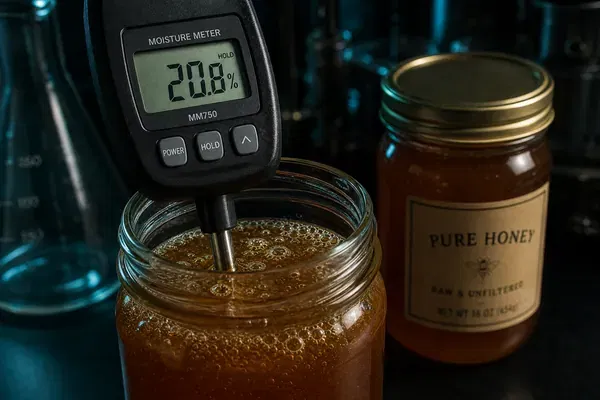
The Packaging Challenge: Glass vs. Plastic Barriers
Glass provides an absolute barrier against moisture vapor transmission, whereas plastic containers inherently allow microscopic moisture exchange over time. When evaluating packaging materials for bulk honey, the Moisture Vapor Transmission Rate (MVTR) is the most critical metric. Plastic containers, such as PET or HDPE, are semi-permeable. While they may seem solid, their molecular structure allows tiny amounts of water vapor to pass through the walls over extended storage periods, especially in high-humidity environments like cargo ships.
A Glimpse into Honey History: The ancient Egyptians understood the importance of airtight seals long before modern science. They stored honey in clay pots sealed tightly with beeswax and resin. When archaeologists opened these pots over 3,000 years later, the honey inside was still perfectly preserved and edible, proving that blocking moisture is the ultimate secret to honey longevity.
In contrast, glass is completely non-porous and inert [2]. It has an MVTR of absolute zero. This means that if honey is bottled at a safe 17% moisture level in a glass jar, it will remain at exactly 17% indefinitely, regardless of external humidity. Furthermore, unlike some plastics that can leach chemicals or absorb delicate floral aromas, glass ensures that the honey’s natural taste and nutritional properties remain pristine from the apiary to the consumer’s table.
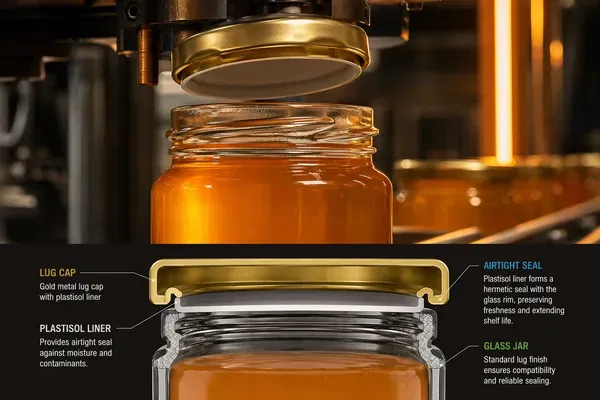
The Solution: Lug Caps and Hermetic Sealing
Pairing glass jars with metal lug caps featuring plastisol liners creates a hermetic vacuum seal that is virtually fail-proof. A glass jar is only as good as its closure. If the lid allows air and moisture to seep in, the barrier properties of the glass are wasted. Metal lug caps are engineered specifically for this purpose. They feature a plastisol (PVC) liner inside the lid. When the cap is twisted onto the jar, the glass rim presses deeply into this liner.
During the packaging process, if the honey is warm-filled or if the jars are passed through a steam capper, the cooling process creates a strong vacuum inside the jar. This vacuum pulls the lug cap down, compressing the plastisol liner against the glass rim to form a hermetic (airtight) seal [3]. This seal is the primary defense against hygroscopic moisture absorption and oxidation. For producers looking to source reliable honey and jam jars, specifying the correct lug finish and liner material is essential. Understanding how closure choices protect shelf life will save your business from costly spoilage claims.
| Packaging Material | Moisture Vapor Transmission (MVTR) | Fermentation Risk in High Humidity | Recommended Closure Type |
|---|---|---|---|
| Glass Jars | Absolute Zero | None (if properly sealed) | Metal Lug Cap with Plastisol Liner |
| PET Plastic | Low to Moderate | Moderate (over long-term storage) | Plastic Screw Cap with Induction Seal |
| HDPE Plastic | Moderate | High (not recommended for long-term) | Plastic Screw Cap |
Conclusion: Securing Your Honey Export Supply Chain
Preventing fermentation in bulk honey requires a proactive approach to moisture control. By ensuring your honey is harvested below the 20% moisture threshold and packaging it exclusively in glass jars with hermetic metal lug caps, you eliminate the risk of hygroscopic absorption during transit and storage. This combination protects your product’s integrity and your brand’s bottom line.
If you are a commercial honey producer or exporter looking to upgrade your packaging to international standards, we would be glad to share how GlassyPack’s premium glass jars and precision-engineered lug caps can safeguard your shipments. Contact us today at sales@glassypack.com or visit our Contact Us page to request samples and a custom wholesale quote.
FAQ
What is the maximum moisture content allowed in honey?
According to the Codex Alimentarius, standard honey must not exceed a moisture content of 20%. Keeping moisture levels between 16% and 18% is highly recommended to completely prevent yeast fermentation.
Why does honey ferment even when it is capped in the hive?
Honey is hygroscopic. Even if it was harvested at a safe moisture level, exposing it to high humidity during extraction, processing, or in porous packaging will cause it to absorb water from the air, triggering fermentation.
Can I use plastic buckets for long-term bulk honey storage?
While plastic buckets are common for short-term transport, they are semi-permeable to moisture vapor. For long-term storage or international export through humid climates, glass containers offer a vastly superior moisture barrier.
What is a plastisol liner in a lug cap?
A plastisol liner is a PVC-based gasket applied to the inside of a metal lug cap. When the cap is twisted onto a glass jar, the rim presses into this soft liner, creating an airtight, hermetic seal that blocks moisture.
How can I tell if my honey jars are properly sealed?
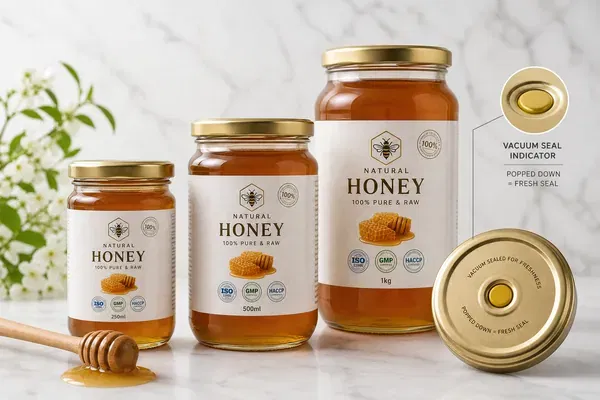
If you use a vacuum sealing process (like warm filling), the center “button” on the metal lug cap should pop down and remain depressed. If the button clicks when pressed, the vacuum seal has been broken or was never properly formed.
References
[1] International Honey Commission. (2018). Legislation of honey criteria and standards. https://www.ihc-platform.net/legislationofhoneycriteriaandstandards.pdf
[2] Roetell. (2025, September 23). The Sweet Science of Packaging: A Comprehensive Guide to Honey Jars. https://www.roetell.com/the-sweet-science-of-packaging-a-comprehensive-guide-to-honey-jars/
[3] HonestBee. (2026, June 15). Why is the proper sealing of honey jars considered a critical component in honey production? https://honestbeeltd.com/faqs/why-is-the-proper-sealing-of-honey-jars-considered-a-critical-component-in-honey-production