You stand in the dairy aisle, faced with a simple choice that feels complicated. You want the best for your family's health and the planet, but the convenience of plastic is hard to ignore.
Glass milk bottles1 are superior for health and the environment. They are non-leaching2, infinitely recyclable3, and designed for reuse, which preserves the milk's pure taste4 and supports a true circular economy5 that single-use plastic6 cannot match.
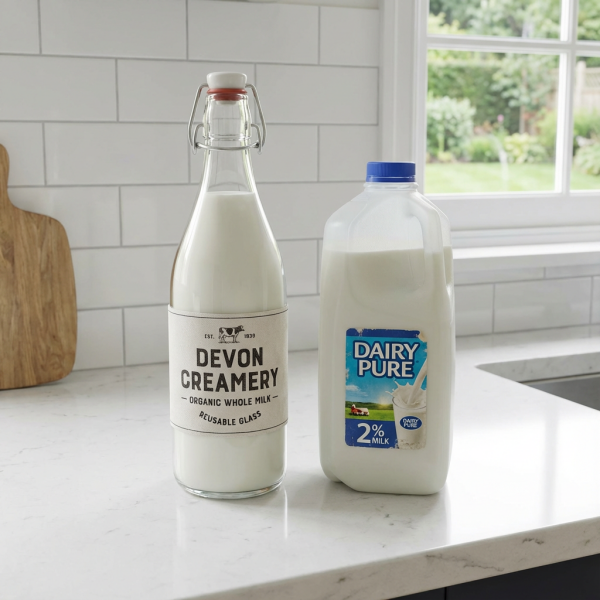
The return of the glass milk bottle isn't just about nostalgia. As someone who supplies glass packaging to brands worldwide, I see this shift every day. It's driven by a growing demand for purity and real sustainability. While plastic offers convenience, glass delivers on the things that truly matter: health, taste, and a healthier planet. Let's break down why.
Why does milk taste better from a glass bottle?
You've noticed that milk from a glass bottle just tastes colder, fresher, and cleaner. You might wonder if it's just your imagination, but there's a real, scientific reason for it.
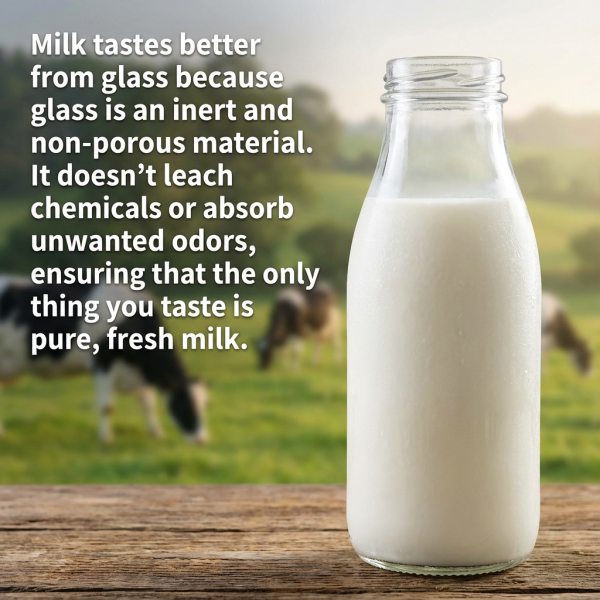
Milk tastes better from glass because glass is an inert and non-porous material. It doesn't leach chemicals or absorb unwanted odors, ensuring that the only thing you taste is pure, fresh milk.
The superior taste of milk from a glass bottle comes down to two key properties of the material itself.
The Purity Advantage
Glass is chemically inert. This simply means it doesn't react with the food or drink it holds. Unlike some plastics, which can leach microplastics or other chemicals into their contents, glass provides a perfect barrier. This guarantees that your milk remains as pure and healthy as it was intended to be, free from any contamination from its container.
The Flavor Preservation
Glass is also non-porous. It doesn't absorb or hold onto old flavors or odors. You've probably noticed how a plastic container can sometimes retain the smell of a strong food, even after washing. Glass doesn't have this problem. Every time you refill or drink from a glass bottle, you're getting a fresh start, with no lingering tastes from previous uses or even fridge odors. Plus, glass is a better insulator, keeping your milk colder for longer.
Is glass really more sustainable than plastic?
You want to make the eco-friendly choice, but you hear conflicting things. Plastic is lighter to ship, but glass is recyclable. Which one truly has a smaller environmental footprint in the long run?
Yes, glass is far more sustainable, especially because it is designed for reuse. It is 100% and infinitely recyclable without losing quality, creating a true closed-loop system that single-use plastic simply cannot replicate.
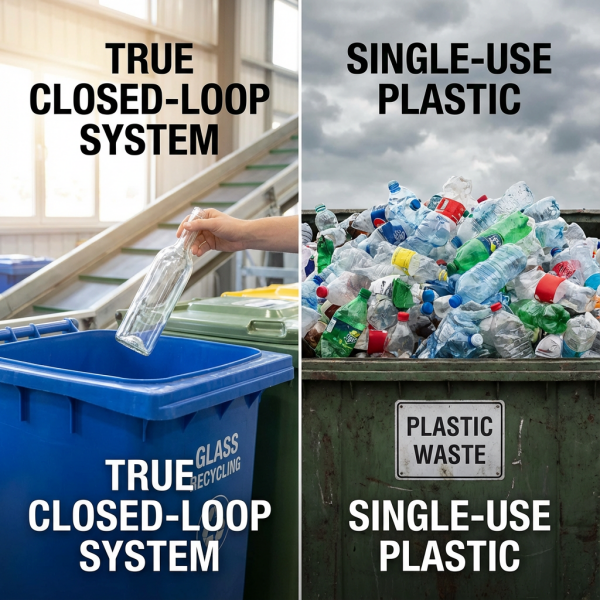
The word "recyclable" can be misleading. To understand true sustainability, we have to look at what happens to the material after it's collected.
The Power of Reuse
The biggest win for glass is its potential for reuse. The classic milkman model, where bottles are collected, sterilized, and refilled dozens or even hundreds of times, is the ultimate circular economy. Reusing a container has a much lower carbon footprint than manufacturing a new one, even from recycled materials. Glass bottles are built tough specifically for this purpose.
Infinite Recycling vs. Downcycling
When a glass bottle is too old to be reused, it can be recycled. This means it's melted down and turned into a brand-new glass bottle of the exact same quality, and this can be done forever. Plastic, on the other hand, is typically "downcycled." A plastic milk jug doesn't become another milk jug; it's turned into a lower-quality product like carpet fiber or a park bench. It's a one-way trip to a lower-grade item, and eventually, the landfill. This is why glass supports a truly closed-loop system, and plastic does not.
If glass is so good, why is plastic everywhere?
It's clear that glass has major benefits for taste and the environment. But you still see aisles dominated by plastic jugs because they are cheap, lightweight, and don't shatter.
Plastic is everywhere due to its low initial cost and convenience. It is lighter to transport and less fragile than glass, which makes it an easier choice for large-scale, low-cost production and distribution.
[image placeholder]
The dominance of plastic is a story of trade-offs. Businesses and consumers often choose short-term convenience and cost savings over long-term benefits. Here is a clear comparison of the two materials.
| Feature | Glass Milk Bottles | Plastic Milk Bottles | Advantage |
|---|---|---|---|
| Chemical Leaching | None (Inert) | High (Microplastics) | Glass |
| Recyclability | Infinite (Closed-Loop) | Limited (Downcycled) | Glass |
| Reuse Potential | High (Designed for reuse) | Low (Single-use focus) | Glass |
| Taste & Purity | Excellent | Fair (Can absorb odors) | Glass |
| Weight & Transport | Heavy (Higher cost) | Lightweight (Lower cost) | Plastic |
| Durability | Fragile | High (Shatterproof) | Plastic |
| Aesthetic Value | High (Premium) | Low (Commodity) | Glass |
As the table shows, plastic's main advantages are practical. It is cheaper to produce and ship, and you don't have to worry about it breaking if it's dropped. For a business focused on minimizing costs, these are powerful incentives. However, these conveniences come at the cost of potential health risks from chemical leaching and a significant environmental burden from single-use waste. The choice for consumers and brands is whether to prioritize that upfront convenience or the lasting quality and sustainability that glass offers.
Conclusion
Glass milk bottles1 are the clear winner for purity, taste, and true sustainability. They offer an investment in a healthier product and a cleaner planet, moving us away from single-use waste.
Explore the advantages of glass milk bottles for health and sustainability. ↩
Learn about non-leaching materials and their impact on food safety. ↩
Discover the recycling process of glass and its environmental benefits. ↩
Find out why glass enhances the taste of milk and preserves its quality. ↩
Understand the concept of a circular economy and its importance for sustainability. ↩
Explore the environmental issues associated with single-use plastic products. ↩