Choosing the right glass bottle size for your vodka brand is a critical decision that goes far beyond simple volume. It impacts your brand positioning, supply chain efficiency, production costs, and ultimately, consumer perception across global markets like North America, Europe, Russia, and Southeast Asia.
This guide, written from the perspective of a leading glass bottle manufacturer, will not only detail the standard sizes but also provide the exclusive commercial insights that will help you make a strategic choice for your next product line.
Part I: The Standard, The History, and The Global Market
While vodka bottles come in a wide array of volumes, one size dominates the global market: the 750ml bottle. To truly understand its significance, we must look beyond the measurement itself and examine its historical and regulatory roots.
Why is 750ml the Global Standard? The Story of the “Fifth”
The 750ml size is not arbitrary; it is a direct result of a regulatory shift in the United States. Before 1976, liquor was commonly sold in imperial measurements, with the most popular size being the “fifth”—meaning one-fifth of a US gallon (approximately 757ml).
In 1976, the U.S. Treasury’s Bureau of Alcohol, Tobacco and Firearms (ATF) mandated the switch to metric measurements for distilled spirits to standardize trade and simplify international commerce. The 750ml size was chosen as the closest metric equivalent to the traditional “fifth,” solidifying its status as the standard size for vodka and most other spirits globally [1]. This historical context is vital for brands targeting the massive North American market.
Quick Reference Table: Common Vodka Bottle Sizes
Understanding the various names and volumes is essential for navigating international markets. The table below provides a comprehensive overview of the most common sizes, their aliases, and typical brand positioning.
Volume (mL) | Volume (oz) | Common Alias | Shots (1.5 oz / 44ml) | Typical Brand Positioning | Best Use Case |
50 mL | 1.7 oz | Nip, Mini, Miniature | 1 | Promotional, Trial, Travel | Airlines, Minibars, Event Giveaways |
200 mL | 6.8 oz | Half-Pint, Flask | 4 | Convenience, On-the-Go | Convenience Stores, Backpacking |
375 mL | 12.7 oz | Pint, Split, Half-Bottle | 8 | Gifting, Premium Limited Edition | Upscale Retail, Cocktail Kits |
500 mL | 16.9 oz | Half-Liter | 11 | Boutique, Craft Spirits | European Markets, Specialty Stores |
750 mL | 25.4 oz | Standard, Fifth | 17 | Global Standard, Mainstream | Retail Shelves, Bars, Restaurants |
1 L | 33.8 oz | Liter | 22 | High-Volume, Duty-Free | Bars (for speed rails), Duty-Free Shops |
1.75 L | 59.2 oz | Handle, Half-Gallon | 39 | Value, High-Volume Party | Large Parties, Budget-Conscious Consumers |
Part II: Visualizing the Difference & Scenario Application
A visual comparison is the best way to grasp the scale of different bottle sizes.
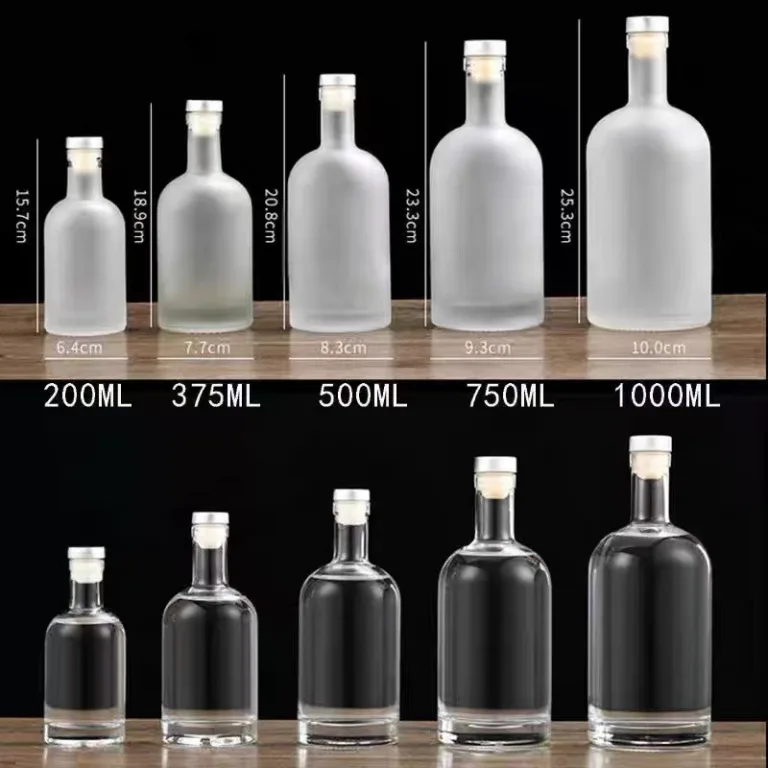
Size Comparison Infographic
The image below clearly illustrates the height and width differences between the most popular vodka bottle sizes, from the compact 200ml to the commanding 1000ml (1 Liter).
Choosing the Right Size for the Occasion
Selecting a size should align with your target consumer’s drinking habits and the retail environment:
•The Travel Companion (50ml – 200ml): Perfect for consumers in Southeast Asia and Europe who prioritize convenience and portability. These sizes are ideal for single servings or sampling new flavors.
•The Gifting & Boutique Choice (375ml – 500ml): These mid-range sizes are popular in premium markets where a smaller, more exclusive presentation is desired. The 500ml size is particularly common in many European countries.
•The Bar & Retail Workhorse (750ml – 1L): The 750ml is the essential size for global retail. The 1L bottle is often preferred by bars in high-volume settings (like Russia and parts of Europe) for its efficiency in speed rails, offering more pours per bottle.
•The Party Starter (1.75L): Dominant in North America and South America, the “Handle” is the go-to for value-conscious consumers and large social gatherings.
Part III: Manufacturer's Commercial Insight: Size and Your Bottom Line
For vodka brand owners, the bottle size is a strategic business decision. As a glass bottle manufacturer, we offer exclusive insights into how size impacts your supply chain and brand strategy.
1. Size and Brand Positioning
The size of your bottle sends an immediate message to the consumer:
•Value Brands: Often utilize the 1.75L “Handle” to signal maximum volume for the price.
•Premium/Craft Brands: Frequently opt for the 375ml or 500ml sizes, often paired with unique shapes (like the square bottle below) to convey exclusivity, limited edition status, or a focus on quality over quantity.
2. Supply Chain Optimization: Cost and Logistics
The choice of size has direct implications for your production and logistics costs:
Factor | Smaller Bottles (e.g., 375ml) | Larger Bottles (e.g., 1.75L) | Strategic Implication |
Raw Material Cost | Higher cost per unit of liquid. | Lower cost per unit of liquid. | 1.75L is more cost-effective for mass production. |
Molding & Production | Requires more units to be produced for the same volume, potentially increasing complexity. | Simpler, fewer units needed for high volume. | Production line efficiency favors larger bottles. |
Transportation & Stacking | Excellent for dense packing; high pallet efficiency. | Pallet stacking can be less efficient due to height/girth; higher risk of damage. | 375ml/750ml often offer the best balance for global shipping. |
Minimum Order Quantity (MOQ) | Generally higher MOQ required to achieve cost-efficiency. | Lower MOQ may be acceptable for initial runs. | Consult your manufacturer for size-specific MOQ advantages. |
3. The Power of Shape: Beyond the Standard Round
While round bottles are the most common, utilizing a unique shape can be a powerful differentiator, especially in competitive markets like Europe and Russia.
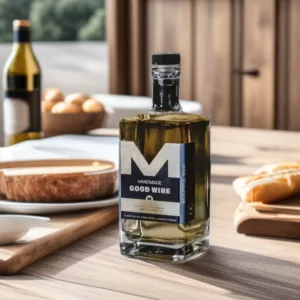
The square bottle, for instance, offers a modern, bold aesthetic that stands out on the shelf and provides excellent surface area for distinctive labeling.
Conclusion: Making Your Strategic Choice
For your vodka brand to succeed in the global market, your bottle size choice must be a strategic alignment of consumer intent, brand identity, and logistical efficiency.
•To satisfy the Informational Buyer: Ensure your marketing materials clearly explain the size, its alias (e.g., “Fifth,” “Handle”), and its historical context.
•To satisfy the Practical Buyer: Use clear visuals and scenario-based marketing to show how your bottle fits their life (party, gift, travel).
•To satisfy the Commercial Buyer (Your B2B Target): Provide the deep, manufacturer-level insights on cost, logistics, and brand positioning that only you can offer.
Ready to design the perfect bottle for your next product launch?
As a specialized glass bottle manufacturer, we offer end-to-end customization, from initial design and 3D modeling to mold creation and high-volume production. Contact us today to discuss your specific needs, get a quote on size-specific MOQs, and optimize your supply chain for success in North America, Europe, and beyond.
References
[1] TTB.gov. Metric Conversions for Wine and Distilled Spirits. https://www.ttb.gov/rulings/metric-conversions-wine-and-distilled-spirits